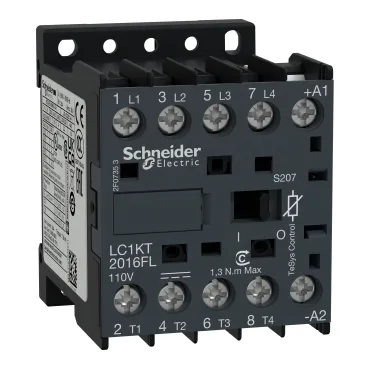
Its 110 V DC coil includes an integral suppression device, so you don't need to add a separate flyback diode or RC snubber across the coil — one less part to spec and mount. Rated for AC-1 utilisation category at 20 A, it handles resistive loads like heaters or lighting banks. The 4-pole configuration gives you four sets of normally-open main contacts for switching multiple phases or independent circuits simultaneously. The contactor carries a safety cover, IP20 finger protection, and V-0 flame retardance per UL 94 — suitable for installation in open control panels where accidental contact is a concern.
The 110 V DC coil operates reliably between 0.7 and 1.3 times nominal voltage (77 to 143 V DC) and drops out at 10% or less of Uc (11 V DC). That wide dropout margin means it won't chatter on a sagging DC bus — useful in battery-backed or lightly regulated supplies. Rated breaking capacity reaches 110 A across 220–440 V AC, tapering to 70 A at 660–690 V AC. That's the current it can safely interrupt under fault conditions — not the continuous rating, but the fault-clearing ability that determines whether upstream protection needs to coordinate. Mechanical durability is 30 million cycles; electrical durability at rated AC-1 load is 180,000 cycles. For a resistive load switching once per minute, that electrical life works out to roughly 125 days of continuous 24/7 operation before contact maintenance is due. The contactor is rated for 3600 operations per hour maximum — one cycle every second. That's fast enough for most cycling heater or lamp applications but not for high-speed motor jogging duty. Power circuit impedance is 3 mΩ at 20 A, 50 Hz, which translates to about 1.2 W of heat at full rated current. The coil hold-in power is 1.8 W at 20 °C — combined thermal dissipation stays under 4 W, so no special ventilation is needed in a standard enclosure.
Power connections use ring-lug terminals with a 7 mm outer diameter, tightened to 0.8–1.3 N·m using a 3.2 mm flat or Philips No. 2 screwdriver. The signalling circuit is fused at 10 A gG per IEC 60947 and VDE 0660.