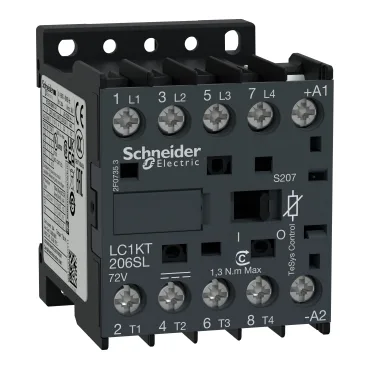
The LC1KT206SLS207 is a 4-pole TeSys LC1K contactor from Schneider Electric, designed for switching resistive loads in control circuits. It carries a 72 V DC low-consumption coil with integral suppression, and the contactor body includes a safety cover. Rated in utilisation category AC-1, this contactor is specified for resistive load switching — not for motor starting (AC-3) or inductive loads. The AC-1 rating at 20 A (Ith) defines its continuous current-carrying capacity in resistive duty. The 72 V DC control coil draws 1.8 W at 20 °C, with an inrush power of 1.8 W and a hold-in consumption of 1.8 W. Operating time is 10...20 ms for coil de-energisation and NO opening, 30...40 ms for coil energisation and NO closing.
The 72 V DC coil is a non-standard control voltage — most panel designs run 24 V DC or 110...240 V AC. Verify your control circuit voltage matches 72 V DC before specifying; the coil operates between 0.7 and 1.3 Uc (50.4...93.6 V DC) and drops out at ≥ 0.10 Uc (7.2 V DC). Rated breaking capacity reaches 110 A at 220...440 V AC, dropping to 80 A at 500 V and 70 A at 660...690 V. The rated making capacity is 110 A AC for the power circuit. These values govern fault-clearing capability — the contactor interrupts faults up to those levels without welding. Mechanical durability is 30 Mcycles; electrical durability is 0.18 Mcycles at 20 A AC-1 at ≤ 440 V. The maximum operating rate is 3600 cycles per hour. For high-cycle applications, the mechanical life is generous but the electrical life at rated current is the limiting factor. The safety cover is included as standard.
Heat dissipation is 1.8 W at 20 °C. Average impedance of the power circuit is 3 mOhm at Ith 20 A 50 Hz.
Certified to BS 5424, IEC 60947, NF C 63-110, VDE 0660, IEC 60077-1/2, EN 45545 (R22 HL3), EN/IEC 60947-4-1, EN/IEC 60947-5-1, UL 60947-4-1, and CSA C22.2 No 60947-4-1. Flame retardance is V0 per UL 94. Overvoltage category III. Safety reliability data: B10d = 1,369,863 cycles at nominal load and 20,000,000 cycles with mechanical load per EN/ISO 13849-1. Protective treatment is TC conforming to IEC 60068 and DIN 50016.