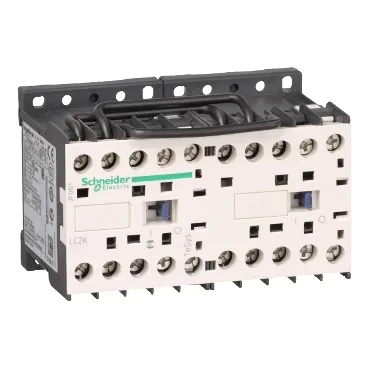
This means it arrives as a mechanically interlocked pair of contactors ready for motor reversing or source transfer duty — no separate interlock kit or busbar wiring to add on the bench. It carries 4 poles, all normally open (4 NO), and is rated for AC-1 resistive load applications. The AC-1 utilisation category per IEC 60947-4-1 means the contactor is specified for switching resistive loads where the inrush current is close to the steady-state value — not for motor starting or high-inductive loads. For motor reversing, you would typically apply the AC-3 or AC-4 rating from the same contactor family; this variant is catalogued for resistive duty. The control circuit is 220...230 V AC at 50/60 Hz, with an inrush power of 30 VA at 20 °C. The coil operates reliably between 0.85 and 1.1 times the rated control voltage and drops out between 0.2 and 0.75 Uc below 50 °C — per the datasheet, this gives a predictable pick-up and drop-out window for panel design.
The rated breaking capacity is 110 A at 440 V, 80 A at 500 V, and 70 A at 660...690 V, all conforming to IEC 60947. The Irms rated making capacity is 144 A at 690 V AC for the power circuit. Electrical durability is 0.3 million cycles at 20 A AC-1 at Ue ≤ 440 V. Mechanical durability is 5 million cycles. The maximum operating rate is 3600 cycles per hour. For a reversing application that cycles frequently — say a conveyor shuttle or pump alternation — the electrical endurance at the actual switched current is the limiting factor, not the mechanical figure. The B10d safety reliability values (1,369,863 cycles at nominal load, 20,000,000 cycles at mechanical load per EN/ISO 13849-1) give the failure rate data needed for safety function calculations if the contactor is used in a safety-related control system. Heat dissipation is 1.3 W. In a densely packed panel, this is low enough that derating due to mutual heating is minimal, but it should still be accounted for in the thermal budget if mounted adjacent to other heat sources. The average impedance of the power circuit is 3 mΩ at Ith 20 A, 50 Hz. This low resistance keeps voltage drop across the contactor negligible at rated current.
The part carries approvals to VDE 0660, NF C 63-110, BS 5424, and IEC 60947. The rated insulation voltage is 600 V per UL 508 and CSA C22.2 No 14, and 690 V per IEC 60947-4-1. These standards and certifications confirm acceptance in European, UK, North American, and other IEC-adopting jurisdictions.