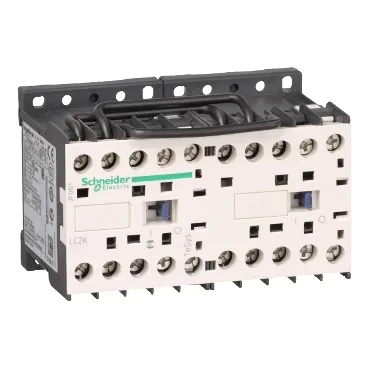
The 230 V AC 50/60 Hz coil pulls in at 0.8 to 1.15 Uc and drops out between 0.2 and 0.75 Uc, with an inrush of 30 VA at 20 °C. Rated for AC-1 resistive loads at 20 A, it handles the steady-state current of heaters, lighting banks, or transformer primaries where the switching duty is non-inductive.
The AC-1 utilisation category (20 A at Ue ≤ 440 V) is the rating that governs real-world selection for resistive loads — it is not a motor-switching figure. For motor reversing you would need the AC-3 rating from a different variant in the same frame. The 4 NO power pole contact composition means all four poles close on energisation; the mechanical interlock prevents both contactors in a reversing pair from closing simultaneously, which is the standard safeguard against phase-to-phase shorts in a reversing starter. The rated breaking capacity of 110 A at 440 V (IEC 60947) tells you the contactor can interrupt a fault up to that level, though the associated fuse recommendation of 25 A gG or 25 A aM sets the practical overcurrent protection limit for the power circuit.
Screw-clamp terminals accept one or two conductors from 0.34 to 4 mm² (solid or flexible with/without ferrule), with a tightening torque of 0.8 to 1.3 N·m using a Philips No. 2 or flat 6 mm driver. IP20 finger protection (per VDE 0106) means it is safe for open-panel mounting but not for washdown environments.