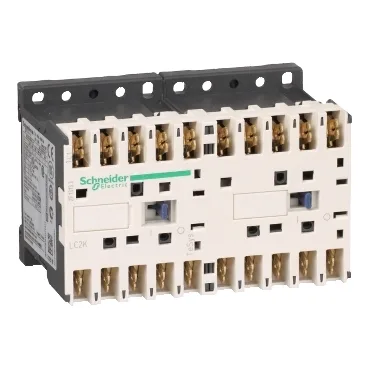
The Schneider Electric TeSys K LC2K16017V7 is a reversing contactor — a preassembled pair of contactors with a mechanical interlock and reversing power busbar, so a single device handles forward/reverse motor direction without external wiring of the interlock. Rated AC-3 ≤440 V 16 A, it switches three-phase squirrel-cage motors up to that current in standard start/stop and reversing duty. The 400 V AC coil pulls in from the line voltage directly, simplifying control wiring in panels where a separate control transformer is not needed. The IP20 finger-safe enclosure (VDE 0106) means the live busbars and terminals are protected against accidental contact — acceptable inside a locked panel, but not for exposed mounting where tools or hands can reach the interior. The 3-pole (3P) configuration with 3 NO power poles covers the motor circuit; the single NC auxiliary contact (1 NC) can be wired into the safety circuit or used as a status feedback to the PLC.
Lifecycle Status and Sourcing Reality
No pin-compatible drop-in replacement exists in Schneider's current TeSys range. A redesign or requalification effort is needed.
It is not the resistive (AC-1) rating, which would be higher. If your motor full-load current is 16 A or less at 400 V, this contactor is correctly sized. The 400 V AC coil is a line-voltage coil — it operates directly from a 400 V phase-to-phase or phase-to-neutral supply, depending on the control circuit design. Verify that your control voltage matches exactly: a 400 V coil will not pull in reliably on 230 V, and applying 480 V will overheat and fail it. The coil consumption is not stated in the evidence; if the PLC output or control relay driving it has a limited VA rating, confirm the coil inrush and hold-in power from the full datasheet before committing the BOM. Mechanical robustness is documented to IEC 60068-2-27 and IEC 60068-2-6: the contactor withstands 10 Gn shocks on Y and Z axes (15 Gn on X) for 11 ms when closed, and 4 Gn vibration at 5–300 Hz when closed. This makes it suitable for installation on machinery with moderate vibration — a conveyor drive or pump skid — but not for high-shock environments like a forging press without additional isolation.
The part carries V1 flame retardance per UL 94, with additional compliance to NF F 16-101 and NF F 16-102 (French railway fire-smoke-toxicity standards). The protective treatment conforms to IEC 60068 and DIN 50016, indicating corrosion resistance suitable for mildly aggressive atmospheres. Operating altitude is 2000 m without derating; above that, dielectric withstand and thermal dissipation must be recalculated. The evidence does not list RoHS or REACH declarations directly, but Schneider Electric typically provides these on request for the TeSys K family — we can attach the declaration of conformity to the RFQ response.