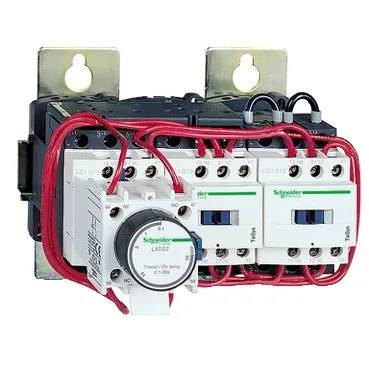
The 230 V AC coil pulls in on that control voltage; screw clamp terminals handle the power and control wiring.
The 115 A rating is in AC-3 (motor switching) duty — that's the current the contactor can make and break across motor loads under normal starting conditions. Don't confuse it with AC-1 (resistive) ratings, which would be higher. The star-delta topology means the contactor set handles roughly 58% of the motor's full-load current per phase during run, so a 115 A unit typically pairs with a motor in the 75–90 kW range on a 400 V supply, depending on duty cycle. Storage range is -60 to 80 °C. The TH protective treatment (IEC 60068-2-30) means it's tested for damp heat, cyclic — so it handles humidity swings in non-condensing environments. Fire resistance at 850 °C (IEC 60695-2-1) and V1 flame retardance (UL 94) cover the material safety requirements for panel builders. Mechanical robustness specs: 2 Gn vibration (contact open), 4 Gn (closed), and shock ratings of 15 Gn closed / 6 Gn open at 11 ms. That's adequate for most fixed industrial installations but not for mobile or high-vibration applications like engine gensets without additional damping.