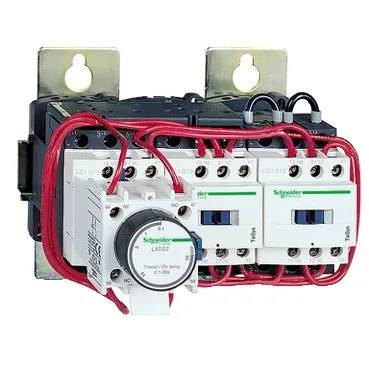
The LC3D150F7A64 is a TeSys D star delta starter from Schneider Electric, part of the TeSys range. It's a pre-wired assembly with 3 x 3P (3 NO) power poles, rated for 150 A in AC-3 utilisation category — that means it's built for switching three-phase induction motors under full load, not just resistive loads. The 110 V AC coil is standard for panel control voltages in European and Asian installations. The star-delta topology reduces inrush current during motor start by wiring the windings in star configuration first, then switching to delta for run. This contactor assembly handles the transition sequence in a single pre-wired package, saving panel wiring time versus discrete contactors.
The starter operates from -40 to 140 °F (-40 to 60 °C), with derating required above 140 °F up to 158 °F (70 °C). Storage range is wider at -76 to 176 °F (-60 to 80 °C). It's rated for operation up to 9842.52 ft (3000 m) altitude without additional derating — fine for most installations outside high-altitude mining or mountain sites. The TH protective treatment per IEC 60068-2-30 indicates it withstands damp heat cycling, so condensation-prone enclosures are acceptable. Fire resistance is rated at 1562 °F (850 °C) per IEC 60695-2-1, and the enclosure material carries a V1 flammability rating per UL 94. These are standard for panel-mount industrial control gear and satisfy most machinery safety audits.
Mechanical robustness for motor starting
The contactor assembly is rated for vibration: 2 Gn at 5-300 Hz when open, 4 Gn at 5-300 Hz when closed. Shock resistance is 15 Gn for 11 ms closed, 6 Gn for 11 ms open. These numbers are typical for TeSys D and adequate for most industrial machinery — conveyors, pumps, compressors — mounted on a rigid panel backplate.