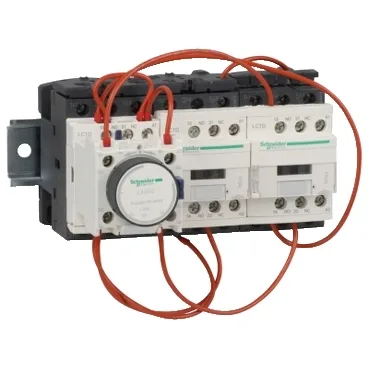
The LC3D180AFE7 is a TeSys D star delta starter from Schneider Electric, configured with 3 x 3P (3 NO) power poles, rated 18 A, and a 115 V AC coil. This is a pre-wired assembly designed for motor starting — specifically, it transitions the motor from star (low inrush) to delta (full running torque) during startup, which is the standard method to reduce starting current on induction motors above a few kW. The AC-3 utilisation category means the contactor set is rated for switching squirrel-cage motors: making and breaking currents up to 6× the rated operational current during starting, and breaking the full load current during running. At 18 A in AC-3, this starter handles motors drawing that line current at the delta-connected run condition — typically a 5.5 kW to 7.5 kW motor on a 400 V three-phase supply, depending on efficiency and duty cycle. The 115 V AC coil is a fixed-voltage design — no interchangeable coil module. Confirm your control voltage matches before wiring; the coil dropout threshold is not specified here, but standard TeSys D practice holds pickup at 85% of nominal and dropout around 20–30% of nominal. Environmental ratings are solid for panel-mount: operating ambient -40 to 70 °C, storage -60 to 80 °C, altitude 3000 m without derating, pollution degree 3 (conductive pollution or dry non-conductive that becomes conductive with condensation — typical for industrial control panels). The front face carries IP2X protection (finger-safe, no tool needed).
Compliance and construction details
Climatic withstand conforms to IACS and IEC 60947-1 Annex Q category D. Protective treatment is TH per IEC 60068-2-30 (damp heat, cyclic). Mechanical robustness: vibrations 2 Gn contactor open, 4 Gn closed (5–300 Hz); shocks 10 Gn open, 15 Gn closed for 11 ms. The 3 x 3P pole configuration (three contactors, each with three NO power poles) is the standard topology for a star delta starter: one line contactor, one star contactor, one delta contactor. The pre-wired assembly reduces panel wiring time and eliminates wiring errors between the three contactors.