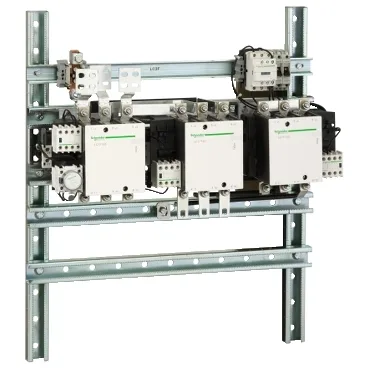
It's rated 185 A in AC-3 duty, which is the category for starting squirrel-cage motors and disconnecting them after they're up to speed — so that 185 A figure governs the motor full-load current you can switch, not a resistive-heater load. At 400 V AC that translates to 160 kW motor power; at 440 V it reaches 185 kW. The assembly contains three contactors — star, line, and delta — with mechanical interlocking to prevent the star and delta contactors from closing simultaneously. The auxiliary contacts are already configured: the star contactor carries 1 NO + 1 NC, the line contactor carries 1 NO + 2 NC, and the delta contactor carries 2 NO + 1 NC. Control voltage is 110 V AC at 50/60 Hz, with a pickup range of 0.85 to 1.1 Uc and dropout between 0.35 and 0.55 Uc.
Below that, the making capacity is 1850 A and the breaking capacity is 1480 A per IEC 60947-4-1 — those are the fault-handling numbers that matter for coordination with upstream protection. The associated fuse recommendation is 315 A gG or 200 A aM at ≤ 440 V; that's the fuse size that keeps the starter within its short-circuit withstand. The closing time is 20 to 35 ms, opening time 7 to 15 ms. Mounting is plate-based, not DIN rail, so factor in the 525 mm width, 110 mm height, and 235 mm depth when laying out the panel. Power connections accept lugs, ring terminals up to 150 mm², or busbars 25 x 3 mm with M8 bolts. Control wiring uses screw clamp terminals accepting 1 to 4 mm² flexible or solid.
The starter is designed and tested to IEC 60947-1, IEC 60947-4-1, EN 60947-1, EN 60947-4-1, and JIS C8201-4-1. Rated insulation voltage is 1000 V per IEC 60947-4-1 and 1500 V per VDE 0110 Group C. Front-face protection is IP2X with shrouds fitted, per IEC 60529 and VDE 0106. The protective treatment is TH for tropical environments.