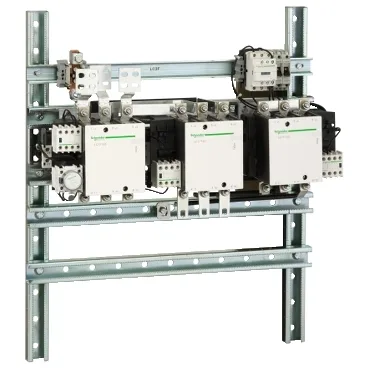
The Schneider Electric LC3F185U7 is a pre-wired TeSys F star delta starter, built for across-the-line starting of three-phase induction motors. It's a complete assembly — three contactors (KM1 star, KM2 line, KM3 delta) with a 240 V AC 50/60 Hz control circuit, pre-wired and plate-mounted, so you don't piece together a star delta from loose parts. Rated for AC-3 duty (squirrel-cage motor starting, switching during running), it handles 160 kW at 380/400 V AC and 185 kW at 440 V AC. That's the rating that governs real motor loads — not a resistive AC-1 number, but the switching of inductive motor inrush.
The AC-3 rating at 160 kW / 400 V is the headline number a buyer checks first — it tells you this starter is sized for a 160 kW, 400 V three-phase motor. The 185 kW at 440 V gives headroom if your line voltage runs high. The 90 kW at 220/230 V covers lower-voltage installations common in some regions. Rated breaking capacity is 1480 A per IEC 60947-4-1, and making capacity is 1850 A — these numbers confirm the contactors can handle the inrush and interrupt fault currents without welding or failing. The associated fuse recommendation of 315 A gG or 200 A aM (up to 440 V) gives the coordination pair for a Type 2 coordination, so you can size your upstream protection. The 240 V AC control coil has a pickup range of 0.85 to 1.1 Uc and dropout between 0.35 and 0.55 Uc at 50/60 Hz. That means it holds in down to about 204 V and drops out reliably below about 132 V — important for brownout ride-through or control transformer sizing. That's a heavy-duty cycling capability — not a concern for standard motor starting, but relevant if the starter sees frequent jogging or inching duty.
This is a plate-mounted unit (not DIN rail), sized for bolting into a panel or enclosure floor. Dimensions are 20.7 in wide by 4.3 in tall by 9.3 in deep — that's a substantial footprint, so check your backplate layout before committing. The power circuit terminates via M8 bolted connections or lugs/ring terminals up to 150 mm², and the control circuit uses screw clamp terminals accepting 1 to 4 mm² flexible or solid wire. IP2X with shrouds on the front face — that's finger protection, not washdown. This starter lives inside a locked panel, not on the machine surface. The TH protective treatment means it's coated for tropical/humid environments, so condensation in an unheated enclosure won't be an immediate problem. Above that, you'd need to account for reduced air density on cooling and dielectric withstand — but for most installations below 3000 m, no derating is needed.
Standards compliance covers IEC 60947-4-1, EN 60947-4-1, and JIS C8201-4-1, plus IEC/EN 60947-1 for the general rules. That's the full set for a motor starter sold into European, Asian, and most global markets. No UL listing is stated in the record, so if your panel requires UL 508, verify the specific plant code or request a UL-marked variant.