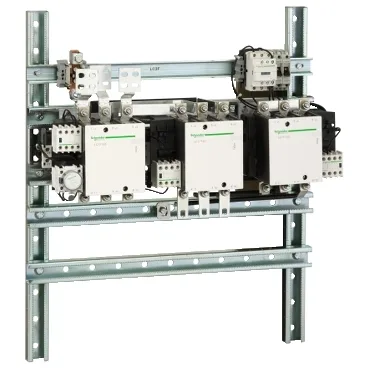
The Schneider Electric LC3F185V7A64 is a pre-wired star-delta starter from the TeSys F range, purpose-built for three-phase induction motor starting. It integrates three contactors (KM1 star, KM2 line, KM3 delta) with mechanical interlocking and a built-in 30-second starting time delay, so you don't need to source and wire separate timers and interlocks for the transition.
AC-3 (IEC 60947-4-1) covers starting and plugging of squirrel-cage motors, so this is the figure that governs real motor sizing. Motor power capability: 160 kW at 380/400 V AC and 185 kW at 440 V AC (50/60 Hz). The 90 kW figure at 220/230 V AC tells you the voltage derating curve — don't try to run a 160 kW motor off a 230 V supply with this starter. Rated making capacity is 1850 A and breaking capacity is 1480 A (both per IEC 60947-4-1). These are the peak inrush and fault-clearing numbers the contactor set can handle during the start sequence or a downstream short — they confirm the assembly can close against locked-rotor current and open under fault without welding. Control circuit is 400 V AC 50/60 Hz, with pick-up between 0.85 and 1.1 Uc and drop-out between 0.35 and 0.55 Uc. That's a standard industrial control voltage in many regions, but if your panel runs 230 V control, this coil won't pull in reliably — you'd need a control transformer or a different coil variant.
Mounts on a plate (not DIN rail — the TeSys F frame is too large for a standard DIN clip). The 525 mm width × 110 mm height × 235 mm depth footprint means you need to plan backplate real estate; this isn't a crowded-panel part. Power connections are M8 bolted lugs or busbars up to 25 × 3 mm, and the control wiring lands on screw-clamp terminals accepting 1 to 4 mm² flexible or solid wire. IP2X on the front face with shrouds (per IEC 60529) means finger-safe but not splash-proof — keep this inside a cabinet, not in a washdown zone.
Designed and tested to IEC 60947-4-1 and EN 60947-4-1 (the main contactor standard for motor starters), plus JIS C8201-4-1 for Japanese installations. Rated insulation voltage is 1000 V per IEC 60947-4-1 and 1500 V per VDE 0110 Group C — that's the clearance and creepage design, not the operating voltage. The protective treatment is TH (tropicalized/humid environment), so it handles high-condensation panels better than a standard untreated contactor.