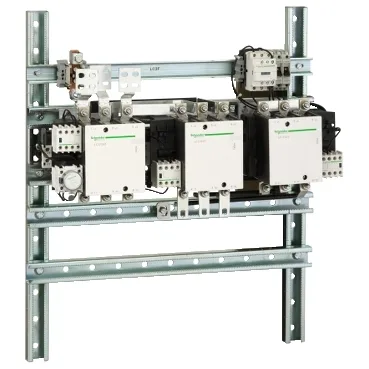
The Schneider Electric LC3F265F7 is a pre-wired TeSys F star delta starter, designed for motor control in AC-3 duty. It switches motors rated from 110 kW on a 220/230 V supply up to 250 kW on a 440 V supply, all at 50/60 Hz. The 110 V AC control circuit is the one to match against your panel's control transformer. This is a 3 x 3P configuration — three power poles, each a 3-phase set — meaning it handles the line, star, and delta contactors internally. The auxiliary contact composition is already wired: 1 NC and 1 NO on the star contactor, 2 NC and 1 NO on the line contactor, 1 NC and 2 NO on the delta contactor. That gives you the feedback signals for your PLC or safety circuit without adding a separate aux block. Rated breaking capacity is 2120 A per IEC 60947-4-1, and the making capacity is 2650 A. That means it can interrupt a locked-rotor fault and close onto a shorted motor without welding the contacts — a real concern on high-inertia loads like conveyors or crushers.
Mounts on a plate, not a DIN rail. The dimensions are substantial: 24.6 inches wide, 4.3 inches tall, 10.5 inches deep. Plan for a backplate that can handle the M10 bolted power connections and the 32 x 4 mm busbar. The power circuit terminals accept lugs up to 240 mm². This is a piece of gear you frame into the panel layout, not something you snap on after the fact. That's touch-safe for the operator side but expects the panel to provide the environmental seal. No washdown rating here — this lives inside a cabinet.
The LC3F265F7 is rated for 110 kW at 220/230 V, 220 kW at 380/400 V and 415 V, and 250 kW at 440 V. If your motor nameplate matches one of those voltage/power combos, this starter handles it. The 20-second starting time is a design parameter for the star-delta transition; longer acceleration profiles may need a different starting method. Mechanical durability is 10 million cycles. That's a high endurance rating for a contactor of this size — expect it to outlast the motor in most industrial duty cycles. Associated fuse ratings are 400 A gG or 315 A aM at up to 440 V. That's your upstream short-circuit protection coordination. The 8 W heat dissipation is the coil holding power — negligible for panel cooling calculations, but worth noting if you're running a densely packed cabinet near the thermal limit.