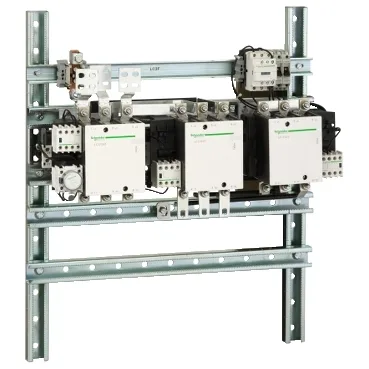
The Schneider Electric TeSys F LC3F265M7A64 is a pre-wired star delta starter designed for motor control applications. It is rated for AC-3 utilisation category, meaning it is built for switching squirrel-cage motors — making and breaking stalled-rotor currents during starting and stopping. The unit integrates three contactors (line, star, delta) with a mechanical interlock, so the star and delta contactors cannot close simultaneously, which is the fundamental requirement for any star-delta transition. The power circuit uses a 3 x 3 NO pole configuration, with power connections via bolted lugs or bars accepting up to 240 mm² cable. Control circuit voltage is 220/230 V AC at 50/60 Hz, with an inrush of 650 VA at cos φ 0.9. The control circuit operates between 0.85 and 1.1 Uc for pick-up and drops out between 0.35 and 0.55 Uc. This is a plate-mounted assembly, not a DIN-rail unit — plan for a backplate or sub-panel in the enclosure.
Motor power ratings are given per voltage: 110 kW at 220/230 V AC, 220 kW at 380/400 V AC, 220 kW at 415 V AC, and 250 kW at 440 V AC. These are the maximum three-phase induction motor loads the starter can handle at those line voltages. The rated breaking capacity is 2120 A per IEC 60947-4-1, and the rated making capacity is 2650 A — these numbers govern the starter's ability to interrupt a fault or close onto a short, so they set the expectations for upstream protection coordination. Associated fuse ratings are 400 A gG or 315 A aM at voltages up to 440 V. This is the maximum fuse size for type-2 coordination — exceed it and you risk the starter welding closed on a fault. Heat dissipation is 8 W, which is negligible for panel thermal calculations but worth noting if the enclosure is densely packed.
The starter is designed and tested to EN 60947-4-1, IEC 60947-4-1, EN 60947-1, IEC 60947-1, and JIS C8201-4-1. These standards cover the performance and safety requirements for contactors and motor-starters. The rated insulation voltage is 1000 V per IEC 60947-4-1 and 1500 V per VDE 0110 group C, so the internal clearances and creepage distances are sized for 690 V systems with margin.