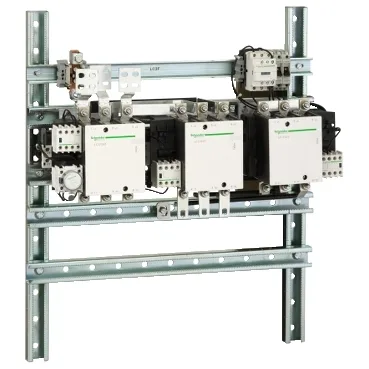
The LC3F265U7 is a pre-wired star-delta starter from the TeSys F range, built for three-phase motor starting across a wide power band — 110 kW at 220/230 V, 220 kW at 380/400 V and 415 V, and 250 kW at 440 V, all at 50/60 Hz. The control circuit runs on 240 V AC 50/60 Hz, with an inrush of 650 VA at cos phi 0.9 and an operating range of 0.85 to 1.1 Uc for pickup, dropping out between 0.35 and 0.55 Uc.
The AC-3 motor power ratings are the headline numbers that decide whether this starter fits your motor nameplate. At 440 V it handles 250 kW; at 230 V it handles 110 kW. That spread covers most European and North American industrial voltages without a separate tap. The 3 x 3P pole configuration means three power poles, each with three normally-open contacts — standard for a star-delta topology where the line, star, and delta contactors each switch one phase set. The auxiliary contact composition is pre-configured: 1 NC and 1 NO on the star contactor, 2 NC and 1 NO on the line contactor, and 1 NC and 2 NO on the delta contactor. That gives you the interlocking and signalling you need without adding a separate aux block. Rated insulation voltage is 1000 V per IEC 60947-4-1 and 1500 V per VDE 0110 group C, so the starter is comfortable in 690 V systems with margin. The IP20 front face with shrouds keeps fingers out but expects enclosure protection for the busbar connections. Associated fuse ratings are 400 A gG or 315 A aM up to 440 V — that is the coordination pair for type-2 protection. If you are doing a selective coordination study, those are the numbers to start from.
This is a plate-mounted unit, not DIN-rail snap-on. The footprint is 24.6 in wide by 10.5 in deep by 4.3 in tall, so plan for a backplate that accommodates the width. Power connections are bolted — M10 bolts or ring terminals up to 240 mm² — and the control circuit uses screw clamp terminals accepting 1 to 4 mm² flexible or solid wire. The pre-wired assembly means the internal star-delta wiring between contactors is already done at the factory. You land the incoming line and motor cables, connect the 240 V AC control supply, and wire the aux contacts into your PLC or control relay. Tightening torque on the power circuit is 35 N.m; control circuit is 1.2 N.m. Maximum operating rate is 2400 cycles per hour at 55 °C.
It complies with IEC 60947-1, IEC 60947-4-1, EN 60947-1, EN 60947-4-1, and JIS C8201-4-1, so it is accepted across European, Japanese, and most Asian markets. The protective treatment is TH (tropicalised), which adds corrosion resistance for humid environments. The specified operating times (40 to 65 ms closing, 100 to 170 ms opening) are fast enough for standard star-delta transition without excessive overlap.