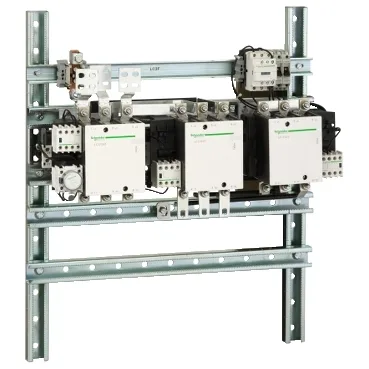
It integrates three contactors (star, line, delta) with mechanical interlocking and the necessary control wiring, so you mount one unit instead of piecing together three separate contactors and an interlock kit. Rated 265 A in AC-3 duty at ≤ 440 V, this starter handles motor loads up to 250 kW at 440 V AC or 220 kW at 400 V AC. The AC-3 category means it is designed for starting squirrel-cage motors and switching them off while running — the standard utilisation category for motor control per IEC 60947-4-1. The control coil is 240 V AC at 50/60 Hz, with an operational range of 0.85 to 1.1 Uc and a drop-out range of 0.35 to 0.55 Uc. Inrush power is 650 VA at 40...400 Hz, cos φ 0.9 at 20 °C; steady-state heat dissipation is 8 W.
The 265 A AC-3 rating is the current the starter can make and break under motor-starting conditions. For a 400 V supply, that translates to roughly 220 kW motor power; at 440 V it reaches 250 kW. If your motor plate calls for a star-delta start at these power levels, this unit is sized correctly. The auxiliary contact complement is built in: 1 NC + 1 NO on the star contactor (KM1), 2 NC + 1 NO on the line contactor (KM2), and 1 NC + 2 NO on the delta contactor (KM3). That is enough for status feedback, interlocking, and a PLC input without adding an external aux block. For a motor starter that sees frequent starts — say a conveyor or compressor cycling every few seconds — that rate is well within the part's capability. The mechanical robustness figures (5 Gn vibration closed, 15 Gn shock closed) confirm it holds contact under industrial vibration.
This is a plate-mount assembly, not a DIN-rail snap-on. Dimensions are 625 mm wide × 110 mm high × 266 mm deep. Plan for a backplate or sub-panel that accommodates the footprint and the M10 bolted power connections. Power circuit terminals accept bar (32 × 4 mm busbar), lugs-ring terminals up to 240 mm², or a connector for 240 mm² cable. Control circuit terminals are screw clamp, accepting 1...4 mm² flexible or solid. Tightening torque for the power circuit is 35 N.m — a substantial connection that needs a torque wrench, not a screwdriver. Control circuit torque is 1.2 N.m. The assembly is pre-wired, so the interlocking between contactors is already in place. The 3 × 3P pole configuration (three power poles per contactor, three contactors) gives 9 NO main poles total. Associated fuse protection is 400 A gG or 315 A aM at ≤ 440 V — coordinate your upstream short-circuit protection accordingly.
The LC3F265U7A64 is a specific pre-wired variant. If your application needs a different control voltage or a non-pre-wired configuration, the TeSys F range includes other order codes.