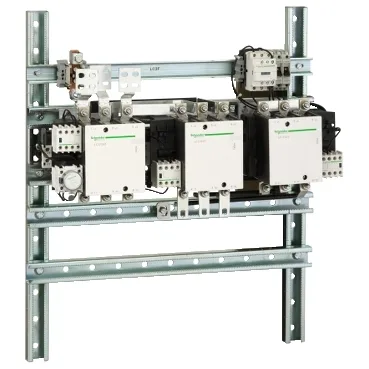
It's built around three 3-pole contactors (KM1 star, KM2 line, KM3 delta) with a fixed interlock — no start-delta mechanical interlock to set up in the field. The auxiliary contact complement is already populated: 1 NC + 1 NO on the star contactor, 2 NC + 1 NO on the line contactor, and 1 NC + 2 NO on the delta contactor. That covers the typical feedback and control logic for a star-delta transition without adding aux blocks.
Rated operational current (Ie) is 265 A at ≤ 440 V AC in AC-3 duty, which is the standard category for squirrel-cage motor starting and running. That 265 A figure governs the motor full-load current the contactor set can switch — not the inrush. The associated motor power spans 110 kW at 220/230 V up to 250 kW at 440 V. For a 400 V line, it handles a 220 kW motor. The rated making capacity is 2650 A (10× Ie), and the breaking capacity is 2120 A (8× Ie), both per IEC 60947-4-1. That means it can close onto and interrupt locked-rotor current without welding or excessive arcing. Control circuit is AC at 50/60 Hz, 400 V nominal. The coil holds between 0.85 and 1.1 Uc (340–440 V) and drops out between 0.35 and 0.55 Uc (140–220 V). Inrush power is 650 VA at cos φ 0.9. That's a healthy pull-in demand — factor it into the control transformer sizing, especially if multiple contactors in the starter close simultaneously. Maximum operating rate is 2400 cycles per hour at 55 °C. Heat dissipation is 8 W total for the assembly. Mounting is plate-mount only — no DIN rail option on this frame size.
Compliance and deployment context
Power circuit connections are bolted, with M10 bolts and bar connections accepting a 32 × 4 mm busbar or ring lugs up to 240 mm². Tightening torque is 35 N·m on the power circuit, 1.2 N·m on the control circuit. The control circuit terminals accept 1 to 4 mm² flexible or solid wire. Associated fuse protection is 400 A gG or 315 A aM at ≤ 440 V.