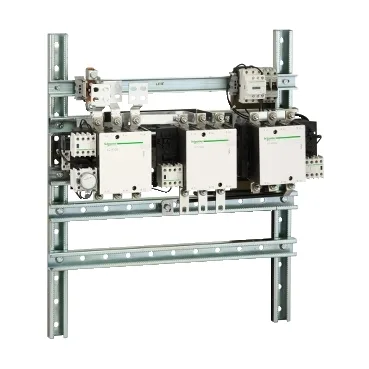
The Schneider Electric LC3F330F7 is a pre-wired TeSys F star delta starter, designed for motor control applications under utilisation category AC-3. It switches motor loads from 160 kW at 220/230 V AC up to 315 kW at 440 V AC, 50/60 Hz. The AC-3 rating means it is specified for starting squirrel-cage motors and switching them off during running — the standard duty for contactors in motor control centres. This unit is a 3 x 3P configuration — three power poles, each with three NO contacts — and includes a full auxiliary contact set: 1 NC and 1 NO on the star contactor, 2 NC and 1 NO on the line contactor, and 1 NC and 2 NO on the delta contactor. That auxiliary complement is enough to handle status feedback and interlocking without adding an external block.
The LC3F330F7 is rated for a making capacity of 3300 A and a breaking capacity of 2640 A, both conforming to IEC 60947-4-1. Those numbers govern its ability to close onto and interrupt starting currents — a 315 kW motor on 440 V can draw several times its full-load current during start, and this starter is sized to handle that inrush without welding contacts. The control circuit is 110 V AC 50/60 Hz, with an operational voltage range of 0.85 to 1.1 Uc and a dropout range of 0.35 to 0.55 Uc. That means it holds in down to about 93.5 V and drops out reliably between 38.5 V and 60.5 V — important for brownout ride-through on a line. Rated insulation voltage is 1000 V per IEC 60947-4-1 and 1500 V per VDE 0110 group C, so it is suitable for 690 V systems common in European industrial panels. The IP20 front-face protection with shrouds (per IEC 60529 and VDE 0106) means it is finger-safe from the front once installed in an enclosure.
Mounting and integration into a panel
This starter is plate-mounted (not DIN-rail), so plan for a backplate or mounting plate in the enclosure. Dimensions are 4.3 in (110 mm) high, 28.5 in (725 mm) wide, and 10.9 in (276 mm) deep — a substantial footprint that needs clear access for the power circuit bolted connections and M10 bolts. Power circuit terminals accept ring lugs up to 240 mm² or busbars 30 x 5 mm. Tightening torque for the power circuit is 35 N.m (309.8 lbf.in) — a torque wrench is required, not a screwdriver. The control circuit terminals are screw-clamp, accepting 1 to 4 mm² flexible with cable end, torqued to 1.2 N.m (10.6 lbf.in).
The associated fuse recommendation is 500 A gG or 400 A aM up to 440 V — a useful reference for the upstream protection engineer.
Compliance and standards coverage
The LC3F330F7 is certified to JIS C8201-4-1, IEC 60947-4-1, IEC 60947-1, EN 60947-1, and EN 60947-4-1. These cover the low-voltage switchgear and controlgear standards for contactors and motor-starters. The TH protective treatment indicates it is tropicalised — suitable for humid or corrosive environments without additional conformal coating.