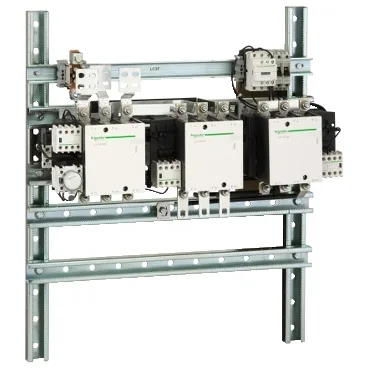
The Schneider Electric TeSys F LC3F400F7 is a pre-wired star delta starter built for motor control in the AC-3 utilisation category — meaning it handles the high inrush of squirrel-cage motors during starting and the full load current during run, without contact welding. It's rated for motor power from 185 kW at 220/230 V AC up to 375 kW at 440 V AC, all at 50/60 Hz. The control circuit runs on 110 V AC, and the unit is delivered as a complete assembly with three power poles (3 x 3 NO) and a full complement of auxiliary contacts: 1 NC + 1 NO on the star contactor, 2 NC + 1 NO on the line contactor, and 1 NC + 2 NO on the delta contactor.
The rated breaking capacity is 3200 A per IEC 60947-4-1, and the rated making capacity is 4000 A per the same standard, so it can handle the locked-rotor surge of motors up to its power range without contact degradation. The associated fuse rating is 500 A gG or 400 A aM at up to 440 V — that's the upstream short-circuit protection the starter is coordinated with; don't oversize it or you lose the Type 2 coordination. The rated insulation voltage is 1000 V per IEC 60947-4-1 or 1500 V per VDE 0110 group C, giving headroom for 690 V systems if derated. The closing time is 40 to 65 ms, opening time 100 to 170 ms, so it's fast enough for reversing or jogging applications. Heat dissipation is 14 W, which is modest for this power class — panel ventilation is still needed but won't drive a fan upgrade. The control circuit voltage limits are 0.85 to 1.1 Uc for operation and 0.35 to 0.55 Uc for drop-out, both at 40 to 400 Hz and up to 55 °C. That means the coil holds in reliably down to about 93.5 V AC and drops out below about 60.5 V AC — useful for brownout ride-through on marginal lines. Inrush power at 20 °C is 1075 VA at 0.9 cos phi, so the control transformer needs to be sized for that peak, not the holding VA.
This is a plate-mounted unit — no DIN rail. The mounting support is plate, and the dimensions are substantial: width 28.5 in (725 mm), height 7.09 in (180 mm), depth 10.9 in (276 mm). That's a big footprint; plan the backpanel layout accordingly. Power connections are bolted: M10 bolts, bar or ring terminals up to 150 mm². The power circuit tightening torque is 35 Nm — that's serious; use a torque wrench. Control circuit terminals are screw clamp, accepting 1 to 4 mm² flexible with or without ferrules, torqued to 1.2 Nm. The protective treatment is TH (tropicalised), which means it's treated against humidity and fungal growth — good for non-conditioned enclosures in warm climates. Operating altitude is up to 3000 m with derating; above that, expect reduced dielectric strength and thermal capacity.
The LC3F400F7 is designed and tested to EN 60947-4-1, EN 60947-1, IEC 60947-1, JIS C8201-4-1, and IEC 60947-4-1. These are the core standards for low-voltage switchgear and motor starters — IEC 60947-4-1 specifically covers contactors and motor-starters, including the coordination requirements for Type 2 protection. The unit also carries mechanical robustness ratings: 15 Gn for 11 ms shocks when closed, 5 Gn for 5 to 300 Hz vibrations when closed, and 6 Gn for 11 ms shocks when open.