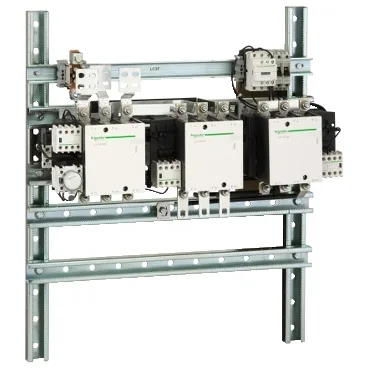
What this TeSys F star delta starter is
The Schneider Electric LC3F400F7A64 is a pre-wired star delta starter from the TeSys F range, built for motor control duty in AC-3 utilisation category. It's a complete assembly — three contactors (KM1 star, KM2 line, KM3 delta) with a mechanical interlock, pre-wired on a plate, ready to bolt into a panel.
Rated operational current is 400 A AC-3 at ≤440 V — that's the motor-switching current, not the resistive-heating rating. AC-3 means switching squirrel-cage motors: making and breaking stalled-rotor current. For a 400 V supply, this unit handles a 315 kW motor; at 415 V it's good for 355 kW, and at 440 V it reaches 375 kW. The 185 kW rating at 220/230 V is there for legacy 200 V-class systems, but the sweet spot is the 380–440 V range where most European and Asian industrial lines run. Rated breaking capacity is 3200 A per IEC 60947-4-1, and rated making capacity is 4000 A — these numbers tell you the contactors can handle the inrush when a motor starts and the arc when it's interrupted under fault. The mechanical durability is 10 million cycles, so this isn't a part you'll swap yearly in a normal-duty line.
Mounting and integration into a panel
This is a plate-mounted assembly, not a DIN-rail snap-on. Dimensions are 725 mm wide, 276 mm deep, 180 mm tall — it needs a backplate or sub-panel with enough real estate. Power connections are bolted via M10 ring terminals or busbar (30 x 5 mm cross-section); control wiring lands on screw clamp terminals accepting 1–4 mm² flexible or solid. Tightening torque is 35 N·m on the power circuit and 1.2 N·m on the control circuit — use a torque wrench on the power lugs; under-torquing M10 connections is a common failure point in high-current starters.
Auxiliary contacts and control wiring
The auxiliary contact configuration is pre-set: KM1 star contactor gets 1 NO + 1 NC, KM2 line contactor gets 1 NO + 2 NC, KM3 delta contactor gets 2 NO + 1 NC. The control circuit voltage limits are 0.85–1.1 Uc for pick-up and 0.35–0.55 Uc for drop-out — if your control voltage sags below 93.5 V AC, the starter may drop out; plan your transformer sizing accordingly.
Sourcing decision
The pre-wired assembly saves panel-build labour, but the fixed 110 V AC coil means you can't field-swap it to a different control voltage — verify your control transformer before committing the BOM line. If you need a different coil voltage, the TeSys F range offers variants; otherwise this unit covers the 315–375 kW motor band at 380–440 V with a single order code.