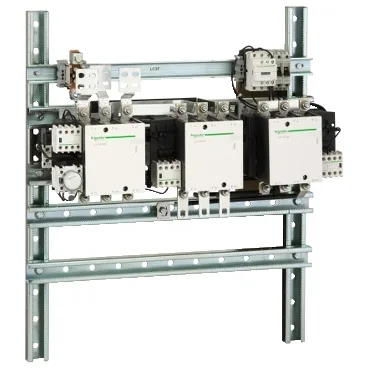
The Schneider Electric LC3F400FE7A64 is a pre-wired TeSys F star delta starter, built as a three-contactor assembly for reduced-voltage starting of three-phase induction motors. It is rated for 400 A operational current in AC-3 duty at ≤440 V, which means it handles the full locked-rotor current during the start transition and the running current in delta — the AC-3 category is the one that governs motor switching, not the higher AC-1 resistive rating. The 115 V AC control coil operates at 50/60 Hz, with a pickup range of 0.85 to 1.1 Uc and dropout between 0.35 and 0.55 Uc. Motor power capability spans 185 kW at 220/230 V up to 375 kW at 440 V, all at 50/60 Hz. The starter includes mechanical interlocking between contactors and a full set of auxiliary contacts: 1 NO + 1 NC on the star contactor, 1 NO + 2 NC on the line contactor, and 2 NO + 1 NC on the delta contactor — no external aux blocks needed for the basic star-delta sequence.
AC-3 means switching squirrel-cage motors: making and breaking the locked-rotor current (typically 6–8× FLA) during start and stop. The rated making capacity is 4000 A and the breaking capacity is 3200 A per IEC 60947-4-1, so it handles the inrush without contact welding. Associated fuse protection is 500 A gG or 400 A aM at ≤440 V. The closing time is 40 to 65 ms and opening time 100 to 170 ms, which matters for coordinating the star-to-delta transition timing.
This is a plate-mount assembly, not DIN-rail — the footprint is 725 mm wide × 180 mm high × 276 mm deep, and the power connections use M10 bolted lugs or busbars up to 30 × 5 mm cross-section. Control wiring terminates on screw-clamp terminals accepting 1 to 4 mm² flexible or solid cable. The front face achieves IP20 with shrouds fitted, which is typical for enclosed panel mounting but not for exposed installation. Heat dissipation is 14 W, so the thermal rise inside the enclosure is modest for a starter of this current class. Operating altitude is 3000 m with derating — above that, the dielectric strength and cooling both drop, so factor that into the panel design if the site is high.
Approvals include compliance with IEC 60947-4-1, EN 60947-4-1, and JIS C8201-4-1. The rated insulation voltage is 1000 V per IEC 60947-4-1 and 1500 V per VDE 0110 Group C. Protective treatment is TH (tropical heat/humidity resistance).