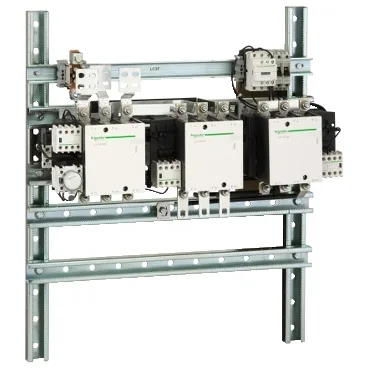
The Schneider Electric LC3F400V7 is a pre-wired TeSys F star delta starter designed for motor control in the AC-3 utilisation category. It handles a rated operational current of 400 A at up to 440 V AC, making it suitable for starting three-phase induction motors in the 185–375 kW range depending on supply voltage (185 kW at 230 V, 315 kW at 400 V, 355 kW at 415 V, 375 kW at 440 V). The control circuit runs on 400 V AC 50/60 Hz, with an inrush power of 1075 VA and hold-in consumption of 15 VA. The starter is pre-wired with three contactors (3 x 3P) and includes auxiliary contacts: 1 NC + 1 NO on the star contactor (KM1), 2 NC + 1 NO on the line contactor (KM2), and 1 NC + 2 NO on the delta contactor (KM3). It has no mechanical interlock between star and delta, relying on the control sequence to manage the transition. The closing time is 40–65 ms, opening 100–170 ms, with a starting time of 20 s.
The 400 A AC-3 rating is the headline figure — it governs the motor load this starter can switch under the standard induction-motor starting duty (make and break during starting, break only at rated current during running). The associated fuse recommendation is 500 A gG or 400 A aM at up to 440 V, which sets the upstream protection. The rated breaking capacity is 3200 A, and the rated making capacity is 4000 A, both per IEC 60947-4-1, confirming it can handle the inrush and fault-clearing demands of a large motor circuit. The heat dissipation is 14 W. The starter is plate-mounted, not DIN-rail, so panel layout must account for the 725 mm width, 276 mm depth, and 180 mm height. Power connections use M10 bolts with busbar cross-section of 30 x 5 mm or ring terminals up to 150 mm². Control wiring accepts 1–4 mm² flexible or solid conductors with screw clamp terminals.
Where it is used and deployment context
This star delta starter is intended for motor control in industrial panels — typically for pumps, compressors, conveyors, and fans where reduced starting current is needed. The operating altitude is up to 3000 m with derating, and the control circuit voltage limits are 0.85–1.1 Uc for operation, 0.35–0.55 Uc for drop-out, across 40–400 Hz.