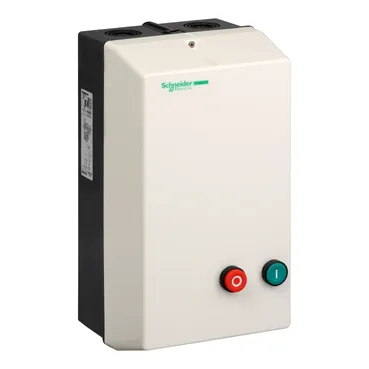
It includes three LC1D contactors, two pushbuttons (green start, red stop/reset), and a polycarbonate enclosure — all pre-wired and ready for line connection. Rated 18 A in AC-3 utilisation category, this starter handles standard squirrel-cage motor loads up to 22 kW at 415 V AC and 18.5 kW at 380/400 V AC. The 415 V AC control circuit coil matches common European three-phase supply voltages without a separate control transformer.
The 18 A AC-3 rating is the operational current for starting and stopping motors under load — the figure that governs real-world motor sizing. AC-3 duty covers starting a squirrel-cage motor and switching it off while running, which is the standard for most pump, fan, and compressor applications. The starter is also rated for 22 kW at 415 V and 22 kW at 440 V, so it fits a 22 kW motor on a 400 V-class supply. The polycarbonate material resists corrosion and impact (IK07 rated), so it holds up in light industrial settings without a separate panel. The starter complies with IEC 60947-4-1, the standard for contactors and motor-starters, which certifies its breaking capacity and coordination under fault conditions.
The enclosure measures 348 mm high by 186 mm wide by 175.5 mm deep — sized to accommodate the three contactors and control wiring inside a single polycarbonate box. Cable entries are pre-punched: four ISO20 and four ISO25 knockouts on top, and the same pattern on the bottom, giving flexibility for incoming supply and outgoing motor cables up to 25 mm gland size. Power and control circuit connections use screw-clamp terminals, which are field-proven for secure terminations in industrial environments. The thermal overload relay is ordered separately, so you select the appropriate overload for the motor full-load current. If mounted in a hot enclosure or near a heat source, derating applies per the manufacturer's thermal curves.
The starter is designed for standard environments and standard motor applications — not for hazardous areas, extreme temperatures, or high-corrosion atmospheres. For those, a different TeSys variant with appropriate coatings or certifications would be needed.