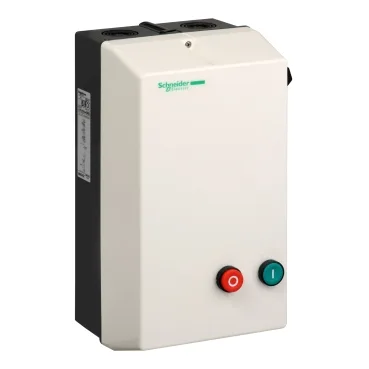
The Schneider Electric LE4D12R7 is an enclosed direct-on-line (DOL) starter from the TeSys LE range, rated for a conventional free air thermal current of 12 A and a control circuit voltage of 440 V AC at 50/60 Hz. It's built for standard motor-starting duty under utilisation category AC-3, which means it handles the high inrush of squirrel-cage motors during start-up and breaks the running current on stop — the common load for a DOL starter on pumps, fans, or small conveyors. The unit comes in a polycarbonate enclosure rated IP65 (dust-tight and protected against water jets) and IK07 (impact resistance to 2 J), so it's suited for washdown areas or outdoor installations where the starter needs to live next to the motor rather than in a central panel. Cable entries are provided on top and bottom for ISO20, ISO25, ISO32, and ISO40 glands — two of each size per face, giving flexibility for incoming supply and outgoing motor leads.
Motor power and fuse coordination
The LE4D12R7 is rated for motor power depending on supply voltage: 3 kW at 220/230 V AC, 5.5 kW at 380/400 V, 415 V, or 440 V, and 7.5 kW at 500 V AC — all at 50/60 Hz. The manufacturer specifies an associated fuse rating of 16 A, type aM (motor-protection), in a 10 x 38 mm cartridge. That fuse size is the upstream short-circuit protection; the thermal overload relay is ordered separately and mounts externally, so the starter body itself is just the contactor and enclosure. Ambient operating temperature is -5 to 40 °C, which is typical for enclosed starters without forced cooling. The push-button control includes a green start and a red stop/reset, both integrated into the lid — no separate pilot devices needed for basic local control.
The LE4D12R7 is designed to IEC 60947-4-1, the standard for contactors and motor-starters. That covers the AC-3 utilisation category rating and the coordination requirements with the upstream fuse. The IP65 and IK07 ratings are conforming to IEC 60529. No specific UL, CSA, or other agency marks are listed in the available documentation, so verify local code acceptance if your site requires third-party certification.