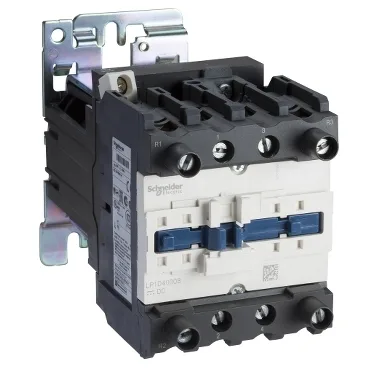
The LP1D400046BW is a 4-pole TeSys D contactor from Schneider Electric, wired for a 24 V DC wide-range coil. It's a panel-mount or DIN-rail part — the mounting support accepts both plate and rail, so it slots into an existing enclosure or a new build without extra brackets. The 4-pole arrangement means it switches three phases plus a neutral or an auxiliary load in one package, which keeps the wiring tidy in motor starter or resistive load circuits. The utilisation categories cover AC-1, AC-3, AC-3e, and AC-4, so it handles resistive heating loads, standard squirrel-cage motors, and the higher-stress plugging/inching duty. That's a broad stroke — most contactors in this class only rate AC-1 and AC-3.
The 24 V DC coil is a 'wide range' type, which typically means it holds in across a saggy DC bus without dropping out — useful if your control transformer is shared with other inductive loads. Inrush power is 19 W at 20 °C, and the average impedance sits at 1.5 mOhm at 60 A, 50 Hz on the power circuit. That low impedance keeps voltage drop negligible under load. Mechanical durability is 10 million cycles; electrical durability is 1.4 million cycles at 60 A, AC-1, up to 440 V. For a motor-duty application (AC-3), expect fewer cycles — that's the nature of breaking inductive current. The rated breaking and making capacity is 800 A at 440 V, which is the fault-closing and fault-breaking ability per IEC 60947. That number tells you the contactor can close into and clear a short-circuit up to that level, assuming the upstream fuse or breaker coordinates properly. Associated fuse rating is 80 A gG at up to 690 V, coordination type 2 for the power circuit. Type 2 means after a fault the contactor is still serviceable — no welding, no replacement needed. That's a spec the panel designer cares about; the MRO guy just wants to know the spare fuse bin is stocked with 80 A gG.
The contactor carries approvals under BS 5424, EN 60947-1, EN 60947-4-1, IEC 60947-1, IEC 60947-4-1, JEM 1038, NF C 63-110, and VDE 0660. That's the full set for European and Japanese panel builds. The TH protective treatment conforms to IEC 60068-2-30 for damp heat, so it won't corrode in a humid panel.
Mounts on plate or DIN rail. Power circuit terminals accept lugs-ring terminals with an external diameter of 13 mm; control circuit terminals take 8 mm lugs. Tightening torque for power circuit is 5 N·m on M5 screws; control circuit is 1.2 N·m on M3.5 screws. Use a flat or Philips No. 2 driver — no special tooling needed. The coil has no built-in suppressor module, so if you're switching the coil with a PLC output or a solid-state relay, add a free-wheeling diode or a varistor across the coil to protect the driver from the inductive kick. That's not a datasheet suggestion; it's a reliability rule for DC coils.