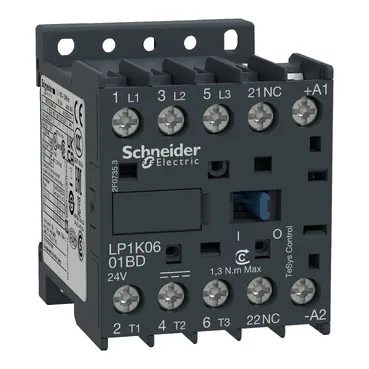
The Schneider Electric LP1K1201FD is a TeSys K three-pole contactor rated for 12 A in AC-3 and AC-3e motor duty at up to 440 V, with a built-in 1 NC auxiliary contact and a 110 V DC coil. It's sized for controlling small to mid-range motor loads in a control panel — think pumps, fans, conveyors that pull under 12 A in the motor circuit. The AC-3 and AC-3e utilisation categories mean it's built for starting and stopping squirrel-cage motors, not just resistive loads, so the electrical durability figures reflect real motor-switching life: 1.3 million cycles at 12 A AC-3, and 300,000 cycles at 20 A AC-1 for resistive loads.
AC-3 is the standard category for starting and disconnecting motors under load — it's harder on the contacts than AC-1 resistive switching because of the inrush. The LP1K1201FD also carries an AC-3e rating, which is the same duty but with an extended electrical endurance profile. If you're switching a 3 kW motor on 400 V three-phase, this contactor is sized right. The 1 NC auxiliary contact is handy for building a holding circuit or feeding a status signal back to the PLC — minimum switching capability is 5 mA at 17 V, so it can handle low-voltage DC signalling without issues.
This contactor carries approvals across multiple jurisdictions: EN/IEC 60947-4-1 and -5-1, UL 60947-4-1 and -5-1, CSA C22.2 No 60947-4-1 and -5-1, plus GB/T 14048.4 for the Chinese market. That means it's accepted in panels destined for Europe, North America, and much of Asia without a separate component-level certification step. The flame-retardance rating is V1 per UL 94, also meeting NF F 16-101 and NF F 16-102 requirements — relevant if the panel goes into rail or transit applications.
Screw-clamp terminals accept solid or flexible wire from 0.34 to 4 mm², with a tightening torque range of 0.8 to 1.3 N·m. The coil draws 3 W inrush and 3 W holding at 20 °C, dissipating 1.3 W of heat — something to account for in a dense panel layout.