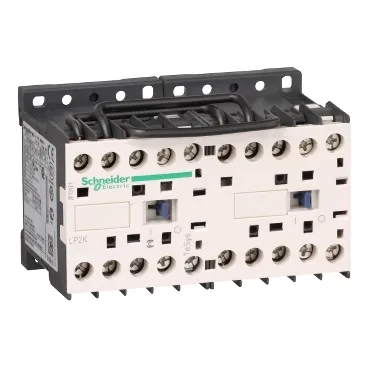
Rated for AC-1 resistive loads at 20 A, it is sized for heater banks, lighting contactor duty, or any application where the load current stays within the resistive switching curve — not for motor starting (that would be AC-3 duty). The 36 V DC control coil draws 3 W holding power and operates within 0.8 to 1.15 times the rated voltage, with dropout between 0.1 and 0.75 Uc below 50 °C — a wide enough band to tolerate a sagging DC supply without nuisance dropouts.
Rated insulation voltage is 690 V per IEC 60947-4-1 and 600 V per UL 508 — the part is suitable for 480 V and 600 V class panels, but the UL listing caps the insulation at 600 V for North American installations. Breaking capacity is 110 A at 440 V, 80 A at 500 V, and 70 A at 660–690 V per IEC 60947 — these are the fault-clearing numbers the contactor can interrupt without welding its main poles, not the continuous current rating. Mechanical durability is 5 million cycles; electrical durability is 300,000 cycles at 20 A AC-1 at up to 440 V — the mechanical figure is the theoretical life, but the electrical figure is what governs replacement intervals in a cycling application.
The 57 mm depth and 90 mm width mean it fits a standard 90 mm wide DIN-rail footprint; the 58 mm height leaves clearance under a typical 200 mm deep enclosure lid.
Listed as current production — this is not an obsolete or NRND part, so it can be specified into a new BOM without a last-time-buy risk. Compliance documentation covers IEC 60947-4-1, UL 508, CSA C22.2 No 14, and NF C 63-110 — the standards a panel builder needs for CE, UL, and CSA listing.