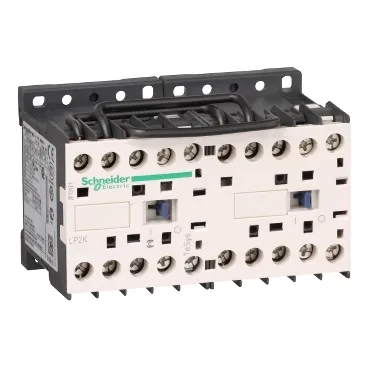
It's a control-duty part (not a power-switching contactor), rated for resistive loads in AC-1 utilisation category. The 72 V DC coil pulls in at 0.8 to 1.15 times nominal and drops out between 0.1 and 0.75 Uc below 50 °C, which gives you a clean margin on a 48 V battery-backed bus or a regulated 72 V supply. Rated insulation voltage is 600 V per UL 508 and CSA C22.2 No 14, and 690 V per IEC 60947-4-1, so it's comfortable on 400/480 V line-to-line systems. Breaking capacity at 440 V is 110 A per IEC 60947, which is well above the 20 A continuous rating — meaning the contactor can interrupt a fault without welding closed. The power circuit impedance is 3 mΩ at 20 A, 50 Hz, so voltage drop across the poles stays under a few tenths of a volt at rated load.
The 20 A AC-1 rating governs continuous resistive current. For motor reversing duty, you'd derate per the AC-3 curve — this contactor is sized for smaller motor loads (typically up to 5.5 kW at 400 V, but verify the specific motor FLA against the AC-3 rating in the datasheet). Mechanical durability is 5 million cycles, and electrical durability is 300,000 cycles at 20 A AC-1, 440 V — that's a long service life for a reversing contactor in a conveyor or pump panel. The screw-clamp terminals accept one or two conductors from 0.34 to 4 mm², solid or flexible, with a tightening torque of 1.3 N·m. That's a standard terminal block torque, so no special tooling needed. Flame retardance is V1 per UL 94, and meets NF F 16-101 and NF F 16-102 Requirement 2 — that's the French railway standard for fire behaviour. If your panel spec calls out NF F 16-101, this part satisfies it without a separate coating or barrier.
Integration notes
The preassembled reversing busbar saves panel wiring time — you land the line and load connections once, and the mechanical interlock prevents both contactors from closing simultaneously. The 72 V DC coil draws 3 W holding power at 20 °C, with an inrush of 3 W at the same temperature. That's a low coil burden, so a small 72 V DC power supply or a PLC relay output can drive it directly, but watch the inrush current if you're paralleling multiple coils on one output. Operating time is 30 to 40 ms for coil energisation and NO closing, and 10 ms for de-energisation and NO opening. That's fast enough for most reversing applications — a contactor changeover in under 50 ms means the motor doesn't coast long between forward and reverse. Maximum operating rate is 3600 cycles per hour, so it can handle frequent reversing in a shuttle conveyor or positioning table.