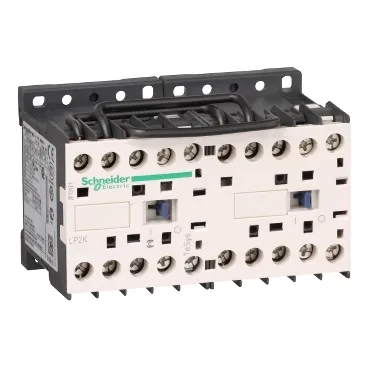
Rated AC-3 at 12 A up to 440 V, it handles reversing duty on small three-phase motors — think conveyors, pumps, or fan drives where direction change is needed. The 48 V DC coil keeps control circuit voltage low, common in PLC-driven panels.
No official successor order code is listed, so a parametric cross-reference to a current TeSys K or TeSys D reversing contactor with matching coil voltage and pole count is the practical path.
AC-3 rating of 12 A at 440 V is the motor-switching figure that governs real use — it tells you the contactor can make and break locked-rotor current for a motor up to roughly 5.5 kW at 400 V. The AC-1 rating (resistive load) will be higher, but for motor duty, the AC-3 number is the one that decides fit. The 48 V DC coil draws from a low-voltage control supply — verify your control transformer or PLC output can source the inrush and hold current. Coil suppression (free-wheel diode) is standard practice for DC coils to protect the driving contact.
Integration notes
Preassembled with the reversing busbar — no extra wiring between the two contactors for the phase reversal. The 3 NO power poles handle the motor lines; the single NO auxiliary contact (1 NO) can be used for status feedback or electrical interlocking. Flame retardance V1 per UL 94 and NF F 16-101/102 compliance suit rail and industrial applications with fire-safety requirements.