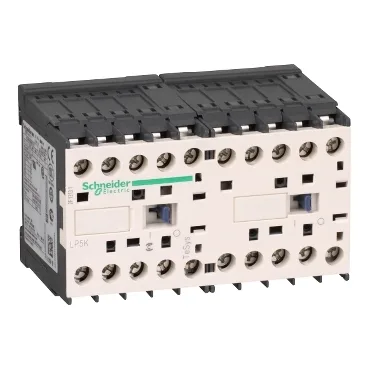
It's rated AC-3 at 12 A up to 440 V, and carries a 48 VDC coil. This is the part you spec when a motor needs to run forward and reverse under control logic — think conveyor reversals, actuator extend/retract, or any two-direction induction motor load. The 48 VDC coil is a common safety-circuit voltage — it keeps the control side away from line voltage and simplifies interfacing with PLC outputs or safety relays.
The 57 mm depth and 90 mm width fit a standard DIN-rail footprint; the preassembled reversing busbar saves you the wiring headache of cross-connecting two contactors. Mount it, land the motor leads on the output side, and the control wires on the 48 VDC coil. Flame retardance meets UL 94 V1 and NF F 16-101/102 — relevant if the panel must pass railway or building fire codes.
Mechanical and electrical robustness
Rated for 15 Gn shocks on the closed contactor (Z-axis) and 10 Gn on the open contactor — that's serious vibration tolerance for a contactor this size. Vibration rating of 4 Gn closed, 2 Gn open across 5-300 Hz. If the panel is on a machine with high impact or continuous vibration, this contactor holds its contacts closed. Utilisation categories cover AC-3 (motor starting/running), AC-4 (plugging/inching), and AC-1 (resistive). The AC-4 rating matters if the motor sees frequent reversals or jogging — that's the harder duty cycle that wears contacts faster. The contactor is built for it.