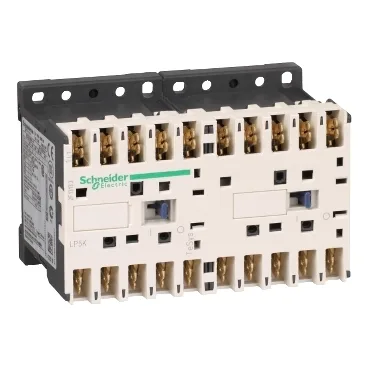
Rated AC-3 at 12 A up to 440 V, it handles reversing motor loads (conveyor direction changes, actuator open/close cycles) within that current envelope. The 12 V DC coil pulls in cleanly on a 24 V DC bus with a dropping resistor or a dedicated 12 V supply. The utilisation categories tell you the load type it is tested for: AC-1 (resistive), AC-3 (squirrel-cage motor starting/running), and AC-4 (plugging/reversing/inching). For reversing duty, AC-4 is the relevant curve — the contactor is rated to break motor currents during reversal, which is harder on the contacts than AC-3 alone.
IP20 finger-safe protection (VDE 0106) means it is suitable for enclosed panels where operators do not contact live parts during normal service. The preassembled reversing busbar saves panel-build time versus wiring two contactors with mechanical interlocks separately.
Flame retardance meets UL 94 V1 and NF F 16-101/102 (railway fire-smoke-toxicity). The protective treatment (TC) conforms to IEC 60068 and DIN 50016 — corrosion-resistant coating for humid or mildly aggressive atmospheres.