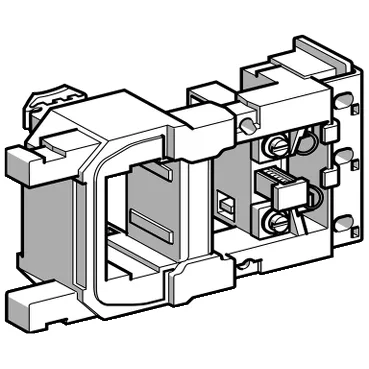
Coil for TeSys F contactors — 480 V AC control
It's the part you swap when the old coil opens or the contactor won't pull in — common failure on high-cycle lines. Latching time runs 35 to 40 ms; unlatching takes 50 to 100 ms. That 15 ms difference matters when you're coordinating with a safety relay or a PLC scan cycle — the dropout delay is the one that catches people out on fast-reversing applications. Coil resistance measures 142.9 Ω for the latching winding and 13,205 Ω for the unlatching winding at 20 °C. The high unlatching resistance means the holding current is low once the contactor seals — keeps the heat down inside a crowded panel.
Rated for 1 million mechanical cycles and a maximum operating rate of 120 cycles per hour at 40 °C. That's a solid duty cycle for a conveyor or pump starter; if your application exceeds 120 cycles/hour, you'll want to look at the TeSys GV or LC1D series with higher mechanical endurance.
Integration notes
At 480 V nominal, that means the coil reliably operates between 408 V and 528 V AC. If your line voltage sags below 408 V, the contactor may drop out — factor that into your brownout ride-through plan. Mounts directly onto the TeSys F contactor base. No special tools needed — just remove the old coil, align the new one, and snap it in. Verify the coil orientation matches the contactor's armature before applying power.