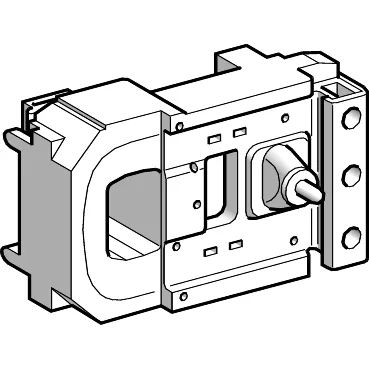
It's the drop-in coil for the LX0FJ device short name — if you're rebuilding a TeSys F contactor that lost its coil or you're stocking spares for a panel full of them, this is the part that matches the nameplate. Coil resistance measures 122 ohms in the latching circuit and 6585 ohms in the unlatching circuit at 68 °F (20 °C). That spread is normal for a dual-winding AC coil — the high-resistance hold winding keeps power draw down once the contactor pulls in. Operating time runs 50 to 100 ms for unlatching and 40 to 75 ms for latching. If you're timing a sequence that depends on when the contactor drops out, use the upper end of that range for worst-case margin.
That's typical for a general-purpose contactor coil — fine for conveyor start/stop cycles or pump control, but not for high-speed jogging applications.
The 440 V AC 50/60 Hz control voltage is the key fit parameter — this coil is designed for 440 V line-to-line control circuits, not 24 V or 120 V. The latching voltage limits are 0.85 to 1.1 times Uc, so it pulls in reliably between roughly 374 V and 484 V. If your control transformer is tapped for 440 V and you're seeing brownout conditions below 374 V, the coil may chatter or fail to latch. The TeSys F range covers contactors from about 115 A to 800 A in AC-3 duty. This coil fits any TeSys F contactor frame that takes the LX0FJ coil variant — verify the contactor body part number against the TeSys F coil compatibility table before ordering, but the LX0FJ designation is the standard 440 V AC coil for that frame size.