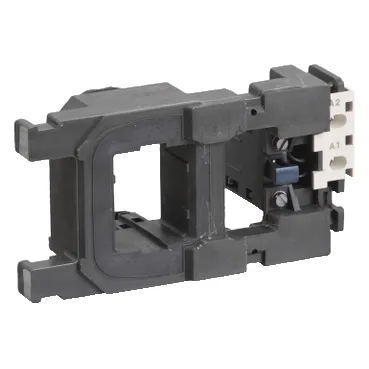
Schneider Electric LX1FH0202 — Contactor & Starter Coils

TeSys LX1FH0202 contactor coil, 20 V AC 40-400 Hz

MPNLX1FH0202
Active

Schneider Electric TeSys F contactor coil, LX1FH0202, 20 V AC 40-400 Hz, 8 W heat dissipation, 10 Mcycles mechanical durability.

Sourced new & surplus through independent channelsAuthenticity-screened · ESD-safe packingListing updated Aug 2026

Specifications

LX1FH0202 — Identification
ParameterValue
Product typeContactor coil
Product rangeTeSys
Device short nameLX1FH
Coil technologyWithout built-in suppressor module
LX1FH0202 — Electrical
ParameterValue
Control circuit voltage [Uc]20 V AC 40...400 Hz
Control circuit typeAC 40...400 Hz
Control circuit voltage limitsDrop-out 0.35...0.55 Uc 40...400 Hz 131 °F (55 °C)) Operational 0.85...1.1 Uc 40...400 Hz 131 °F (55 °C))
Coil resistance (avg.)0.8 Ohm inrush 68 °F (20 °C) 20 Ohm holding 68 °F (20 °C)
LX1FH0202 — Power & Thermal
ParameterValue
Inrush power (VA)650 VA 40...400 Hz cos phi 0.9 (at 68 °F (20 °C))
Hold-in power (VA)10 VA 40...400 Hz cos phi 0.3 (at 68 °F (20 °C))
Heat dissipation8 W 40...400 Hz
LX1FH0202 — Performance & Durability
ParameterValue
Operating time100...170 ms opening 40...65 ms closing
Max. operating rate2400 cyc/h 131 °F (55 °C)
Mechanical durability10 Mcycles
LX1FH0202 — Environmental
ParameterValue
Operating temperature23...131 °F (-5...55 °C)

Product details

The LX1FH0202 is a TeSys F contactor coil — the replaceable solenoid that pulls in the main contactor armature. It's a 20 V AC coil rated for 40-400 Hz supply, meaning it works on standard 50/60 Hz control transformers as well as higher-frequency circuits up to 400 Hz (common in aerospace or genset-derived supplies). Opening time runs 100-170 ms, closing 40-65 ms. That's a deliberate slow-open characteristic — helps manage arc extinction on the main contacts. The coil draws 650 VA inrush (cos φ 0.9) and settles to 10 VA holding (cos φ 0.3). Heat dissipation is 8 W across the frequency range. No built-in suppressor module, so you'll need an external RC snubber or varistor across the coil if driving it from a PLC output or solid-state relay. Coil resistance is 0.8 Ω inrush, 20 Ω holding at 20 °C.

That's a solid baseline for general-purpose switching; if you're cycling faster or at higher ambient, the thermal derating curve applies (not shown here, but standard for the TeSys F family).

What to watch when specifying

Drop-out threshold is 0.35-0.55 Uc (7-11 V AC) at 55 °C; operational pickup is 0.85-1.1 Uc (17-22 V AC). If your control transformer sags under inrush from other loads, ensure the voltage stays above 17 V during the pickup transient or the coil may chatter. That's typical for panel-mount contactor coils — fine inside a ventilated enclosure, but not for direct outdoor exposure or hot-aisle environments without derating.

Frequently asked questions

What is the closest pin-compatible alternative to LX1FH0202 in the TeSys F family?

Within the TeSys F range, the LX1FH series shares the same mechanical footprint and coil termination. The LX1FH0202 is the 20 V AC variant; other LX1FH order codes cover different control voltages (e.g., 24 V, 48 V, 110 V, 230 V AC). The physical coil dimensions and mounting are identical across the voltage range, so swapping to a different LX1FH voltage is a direct fit if your control circuit changes.

What compliance documentation does Schneider provide for LX1FH0202?

As a standard TeSys F component, it carries CE marking for the European market. RoHS and REACH compliance declarations are available from Schneider's documentation portal. UL/CSA listing is typical for the TeSys F contactor range, but specific certification for this coil order code should be verified against the product certificate or nameplate marking.

MPN
LX1FH0202