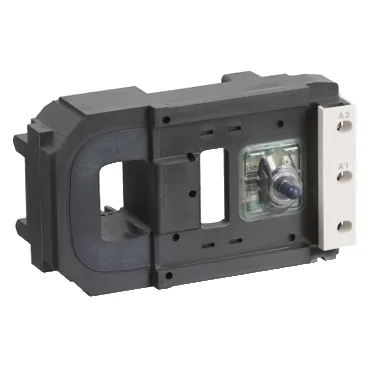
It is not a general-purpose coil; it is designed to drop into the F-frame contactor's magnetic circuit and is rated for the mechanical duty cycle of that platform.
Control voltage is 50...56 V DC or 57...62 V AC 40-400 Hz. The coil holds in at 0.85 to 1.1 Uc at 55 °C and drops out between 0.3 and 0.5 Uc. Opening time is 60 ms, closing 20 ms. That asymmetry is typical for a large-frame contactor where the spring force for break is stiffer than the magnetic pull-in. The 3600 cycles/hour maximum at 70 °C means it can follow a fast-pulsing load profile, but for continuous high-rate applications like a welding gun you would want to check thermal rise against the 11.4 to 13.9 W heat dissipation. Mechanical durability is 10 Mcycles — that is the life of the coil's own plunger and return spring, not the contactor's main contacts. In a typical motor-start application cycling a few times an hour, that translates to decades of service. No built-in suppressor module means the coil's magnetic field collapses without internal damping. For a 500 VA inrush coil, that can generate a significant inductive kickback spike. If the control circuit uses a PLC output or solid-state relay, an external flyback diode (DC) or RC snubber (AC) across the coil terminals is recommended — the contactor's own aux contacts do not supply that protection.
Deployment context
The coil is a plug-in replacement accessed by removing the contactor's arc chute and magnet assembly.