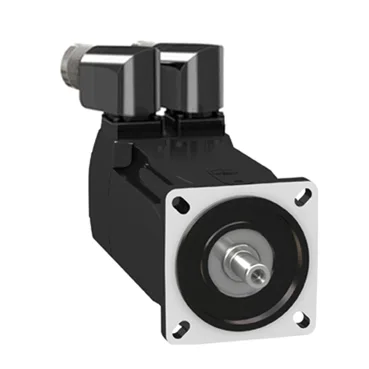
The MH30701P07F2200 is a 930 W continuous-power servo motor from Schneider Electric's MH3 series, spinning at 5500 rpm nominal. That speed puts it in the high-speed class — good for direct-drive spindles, packaging cutoffs, or any axis where you want to skip a gearbox and run the load at motor speed. Nominal torque is 1.38 N.m when paired with an LXM52 drive at 115 V three-phase input, and it derates slightly to 1.27 N.m at 480 V three-phase. The peak stall torque hits 4.2 N.m across the 115–480 V three-phase range — that's the short-term muscle for acceleration through a cycle. The holding brake delivers 3 N.m static torque, enough to hold a vertical load or keep a position on power loss without the drive holding current. Brake pull-in power is 7 W — small enough that the holding brake won't cook the motor in a stalled condition.
Encoder feedback and sealing — field-install realities
The Multiturn SinCos Hiperface encoder gives absolute position over multiple revolutions, so the controller knows the shaft angle at power-up without a homing move. That saves a few seconds per cycle on machines that cycle power between batches. IP65 rating means the motor body and the connector interface are sealed against hose-directed water — fine for washdown zones in food plants or outdoor conveyor sections. The shaft seal is the weak point at sustained high rpm; the radial force limits drop from 660 N at 1000 rpm to 360 N at 6000 rpm, so a belt-driven load at top speed needs a bearing check. Natural convection cooling — no fan, so the motor relies on its own surface area to shed heat. The continuous stall torque is 1.4 N.m across the voltage range, which is essentially the thermal limit at zero speed. If the duty cycle keeps the motor near stall, expect the 135 °C copper hot limit to be the binding constraint.
The motor mates with Schneider LXM52 and LXM62 drive families — the nominal torque figures in the spec table are measured with those drives at the stated input voltages. If you're replacing an existing motor in a Lexium system, verify the drive model and the feedback cable pinout before committing.