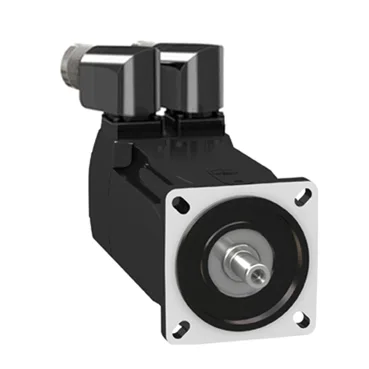
The MH30702P17A2200 delivers 1380 W continuous power at 5500 rpm nominal speed — this is the sustained output for constant-velocity moves like conveyors or spindles. The nominal torque at the shaft is 2.37 N.m when paired with an LXM52 drive at 115 V three-phase, derating to 1.89 N.m at 480 V three-phase. For short-duration acceleration, the peak stall torque reaches 7.4 N.m at 115-480 V three-phase, but the continuous stall torque is 2.48 N.m — the thermal limit for holding or low-speed positioning. The torque constant of 0.84 N.m/A at 120 °C lets you convert drive current setpoints directly to shaft torque for tuning the current loop. Back EMF is 54.08 V/krpm — at 5500 rpm the motor generates 297 V line-to-line, so the drive's DC bus must stay above that to maintain current control. Stator inductance is 12.19 mH and resistance 3.84 Ohm, giving an electrical time constant of about 3.2 ms — the current loop bandwidth should be set below 300 Hz to avoid instability.
Encoder feedback and mechanical interface
The Multiturn SinCos Hiperface encoder provides absolute position feedback over 4096 revolutions — no homing cycle is needed after a power cycle, which saves time on multi-axis machines. The encoder signals are analog sine/cosine with a digital commutation track, so the drive can interpolate position to sub-micron resolution. The connector uses rotatable right-angled connectors for flexible cable routing in tight cabinets. The shaft is 11 mm diameter with a parallel key, 23 mm shaft length, and a 4 mm key width. The motor flange is 70 mm with a 60 mm centring collar and 2.5 mm collar depth — this matches standard IEC 71 frame dimensions, so it bolts directly to common gearboxes and linear actuators without adapters. Maximum radial force at the shaft is 710 N at 1000 rpm, derating to 390 N at 6000 rpm — factor this into bearing life calculations for belt-driven loads.
IP65 and cooling — where it runs
The motor carries IP65 protection — sealed against dust ingress and water jets from any direction. This suits washdown environments in food processing, packaging, or machining centres where coolant spray is present. Cooling is natural convection — no fan, so the motor relies on heat dissipation through the housing and mounting flange. In a confined cabinet or at continuous full load, expect surface temperatures up to 135 °C copper hot; ensure clearance for airflow and consider a thermal break if mounting to heat-sensitive components.