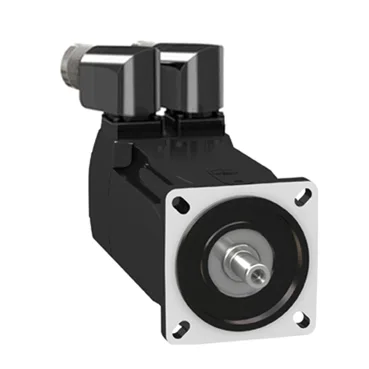
70 mm flange, 1380 W — sizing the axis
The MH30702P12F2200: This is a three-phase servo motor with a 70 mm (2.8 in) flange, 1380 W continuous power, and a 5500 rpm nominal speed — the sizing reference is MH30702P, so it sits in the compact end of the MH3 family for applications needing moderate torque at high speed. The nominal torque is 2.37 N.m (20.98 lbf.in) when paired with an LXM52 drive at 115 V three-phase supply, but the same motor delivers 1.89 N.m at 480 V three-phase with the same drive — the torque constant of 0.84 N.m/A at 120 °C copper means the drive's current limit directly sets the usable torque, so matching the drive and supply voltage to the load cycle is the first sizing step. Peak stall torque is 7.4 N.m (65.5 lbf.in) across the 115...480 V three-phase range, giving a 3:1 peak-to-continuous ratio for acceleration and emergency stops.
The holding brake delivers 3 N.m (26.6 lbf.in) holding torque with a pull-in power of 7 W — this is sized for vertical-axis loads where the motor must hold position when the drive is disabled; the brake engages on power loss, so the load stays put without a mechanical lock. Feedback is a multiturn SinCos Hiperface encoder — absolute position is retained over multiple shaft revolutions, so the axis does not need a homing cycle after a power cycle. The encoder type also determines which drive models are compatible; the LXM52 and LXM62 families listed in the torque table both support Hiperface.
Radial load limits and mechanical integration
Maximum radial force on the shaft is 710 N at 1000 rpm, derating to 390 N at 6000 rpm — the bearing load capacity drops with speed, so a belt-drive or overhung load application must be checked against this curve to avoid premature bearing failure. The shaft is 11 mm (0.4 in) diameter with a parallel key, 23 mm (0.9 in) shaft length, and a 4 mm (0.2 in) key width — standard for coupling to gearboxes or pulleys in this frame size. The centring collar depth is 2.5 mm (0.10 in), so the mating flange pilot must match this depth for concentric alignment. Natural convection cooling — no external fan or forced air required, but the motor's continuous torque rating assumes free airflow around the housing; mounting in a confined space or near heat sources will require derating.