Torque and speed profile for load matching
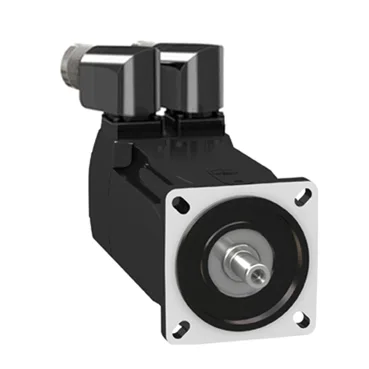
The MH30702P16F2200: Rated 1380 W continuous power at 1250 rpm nominal speed, with a continuous stall torque of 2.48 N·m across the 115–480 V three-phase range — this is the holding torque the motor can sustain indefinitely without overheating, not the peak that clears a jam. Peak stall torque reaches 7.4 N·m at 115–480 V three-phase, giving a 3:1 torque overload margin for acceleration transients or short-duration overload events common in indexing and pick-and-place cycles. Nominal torque varies with supply voltage: 2.37 N·m at 115 V three-phase, 2.23 N·m at 230 V single-phase, 2.01 N·m at 400 V three-phase, and 1.89 N·m at 480 V three-phase — the torque derating above 115 V reflects the drive's current limit, not the motor's thermal capability.
Encoder, brake, and environmental sealing
Single-turn SinCos Hiperface encoder provides absolute position within one revolution — no homing sequence needed on power-up for rotary applications, but multi-turn position is lost if the drive loses power and the motor rotates. Integrated holding brake rated 3 N·m holding torque, with 7 W pull-in power — the brake engages when power is removed, holding the load on a vertical axis or during an E-stop; the 7 W coil power means a small 24 VDC supply can drive it without a separate brake rectifier. IP65 standard protection means the motor body is sealed against dust ingress and low-pressure water jets — suitable for washdown areas in food processing or machining coolant splash, but not for submersion or high-pressure spray (IP67 or IP69K would be needed for those).
Mechanical fit and shaft interface
70 mm flange (IEC standard) with a 60 mm centring collar and 5.5 mm mounting holes — bolts directly to a standard NEMA 70 or IEC 70 frame mount without adapter plates. 11 mm shaft diameter with a parallel key, 23 mm shaft length, and 4 mm key width — the key transmits torque to the load coupling; the 0.2 in (4 mm) key width means the keyway in the mating hub must be broached to that width, not a standard 5 mm metric key. Maximum radial force at the shaft centre drops from 710 N at 1000 rpm to 390 N at 6000 rpm — belt-driven loads must be sized against the operating speed's force limit, not the static rating, to avoid bearing overload.
Electrical parameters for drive tuning
Stator resistance 3.84 Ω and inductance 12.19 mH give an electrical time constant of about 3.2 ms — the drive's current loop bandwidth must be set below the pole frequency to avoid oscillation; typical Lexium 52/62 drives auto-tune this on commissioning. Back EMF constant 54.08 V/krpm means the motor generates 54 V phase-to-phase for every 1000 rpm of mechanical speed — at 1250 rpm nominal, the back EMF is about 67.6 V, leaving headroom for the drive's bus voltage to push current into the windings. Continuous stall current 2.94 A and maximum current 9.68 A — the drive's continuous current rating should match the 2.94 A stall current for thermal balance; the 9.68 A peak supports acceleration and deceleration transients within the drive's overload envelope.