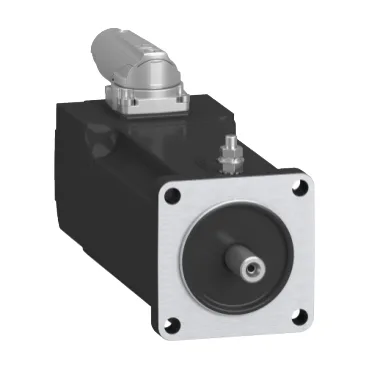
SH3 55 mm flange, Hiperface DSL — what lands on the panel
The Schneider Electric SH30551P0AA4000 is a member of the SH3 servo-motor family with a 55 mm international-standard flange footprint, smooth 9 mm shaft, and an absolute single-turn Hiperface DSL encoder on a rotatable right-angle quicklock connector (cites:). Lifecycle stage is current, so the part is on the active catalogue line (cites:). The body carries IP65 at the motor housing with IP54 at the shaft bushing when no seal ring is fitted (cites:). Servo motors in this class drive the rotary axis on a packaging, pick-and-place, or feed-and-cut line under a Lexium or third-party drive, using Hiperface DSL to push absolute single-turn position and commutation data over a single cable pair back to the servo drive (cites:). The 55 mm flange and 132.5 mm length put it in the small-frame bracket shared by light-duty index tables, labelling heads, and small gantry axes where inertia matters more than stall torque (cites:).
Nominal output power is 160 W on a 230 V single-phase supply and 290 W on either 400 V or 480 V three-phase rails, with a 290 W continuous-power figure on the same envelope (cites:). Nominal torque follows the same shape: 0.5 N·m at 230 V single-phase against 0.35 N·m on the 400 V and 480 V three-phase rails, the lower figure reflecting the higher current-loop bandwidth available when the bus is stiffer (cites:). Nominal speed tracks the supply: 4000 rpm at 230 V single-phase, 8000 rpm at 400 V three-phase, and 9000 rpm at 480 V three-phase, with the mechanical ceiling matching the 480 V rating at 9000 rpm (cites:). For a sizing engineer this means a single SKU drives axes with very different speed demands by selecting the bus voltage; the motor, flange, and encoder stay the same (cites:). Continuous stall torque lands at 0.42 N·m across the 115 V to 480 V three-phase range, with a continuous stall current of 0.73 A drawing through the windings (cites:). Peak stall torque reaches 1.5 N·m at the same 115 V to 480 V three-phase window, so the motor can briefly deliver roughly 3.5× its continuous torque before the drive's current limit or the motor's thermal curve intervenes (cites:). The drive sizing constants are recorded for the parameter set: torque constant 0.58 N·m/A at 120 °C, back-EMF constant 40 V/krpm at 20 °C, stator resistance 41.8 Ohm, and stator inductance 37.13 mH (cites:). Maximum Irms and 3-second peak current both sit at 2.9 A, a figure the drive commissioning engineer uses to set the current loop gain and the peak torque limit (cites:).
Mechanical envelope, mounting, and shaft load limits
Cooling is natural convection, so there is no fan or IP-rated duct to fail; the copper-hot thermal limit of 130 °C is what the drive's I²T model monitors against when sizing the continuous load (cites:). For a panel builder integrating the motor into a sealed machine the IP65 housing rating carries through the cable outlet, while the shaft bushing drops to IP54 unless a shaft seal ring is fitted (cites:).