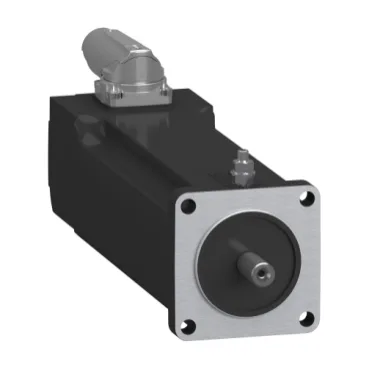
What the SH3 designation buys you
SH30553P0BA4100 is the SH3 servo-motor size 55 mm flange unit in the current Schneider Electric lineup, sized at 680 W continuous with the smooth 9 mm shaft and a Hiperface DSL absolute multiturn encoder. It carries IP65 on both motor body and shaft bushing per IEC 60034-5, which means it tolerates panel-side splash and dust in a typical machine-room environment — though the catalogue line labels it as a brake-spec motor, the entry here is the Without-holding-brake variant, so the brake interface is not wired. The encoder choice is the load-bearing selection: Hiperface DSL runs the feedback over a single cable pair, which simplifies commissioning compared to a multi-conductor resolver harness — though the drive on the other end must accept DSL or the feedback channel has to land through a protocol gateway.
Speed, torque and current envelope
Nominal speed depends on the supply it sees: 4000 rpm on single-phase 230 V, 8000 rpm on three-phase 400 V, and 9000 rpm on three-phase 480 V — maximum mechanical speed is 9000 rpm, so the 480 V condition is the upper limit of the safe operating envelope. Continuous output power is 390 W on single-phase 230 V and 680 W on three-phase 400 V or 480 V; continuous stall torque is 1.05 N.m at 115...480 V three phase and peak stall torque reaches 3.5 N.m across the same range — the three-phase figure is the one the sizing calc should use, not the single-phase headline. Continuous stall current is 1.7 A and the 3-second peak output current is 6.5 A, which sets the drive's peak-current rating and acceleration-cap sizing. Nominal torque tracks the supply: 1.1 N.m at single-phase 230 V and 0.81 N.m at three-phase 400 V or 480 V; the torque constant 0.62 N.m/A at 120 °C is the figure to use in the drive's current-loop tuning, not the 25 °C value.
Winding and thermal data for the drive's parameter set
Stator resistance 10.4 Ohm and stator inductance 13.02 mH — entered into the drive's motor model, these set the current-loop bandwidth and the field-weakening boundary. Back-EMF constant 41 V/krpm at 20 °C — at 9000 rpm the regenerative bus sees roughly 370 V of back-EMF, so the drive's DC-bus rating must clear that with margin. Cooling is natural convection with a copper-hot temperature ceiling of 130 °C — derate continuous torque above 40 °C ambient per the manufacturer curve; the heatsink is the motor housing, not an external fan.
Mounting geometry and shaft load
Body length 176.5 mm on an international-standard flange with 40 mm centring collar, four 5.5 mm mounting holes and a 2 mm centring-collar depth — a standard NEMA-style 55 mm bolt circle fits without adapter plate. Shaft is 9 mm diameter × 20 mm length with a smooth (non-keyed) end; maximum radial force 710 N at 1000 rpm and maximum axial force 80 N — direct-coupled loads stay well inside the envelope, belt drives need the pulley sized against the radial-force curve.
Sourcing posture for a current-production servo
Lifecycle stage entry is current — meaning the part is on the active Schneider Electric catalogue line and is not flagged for phase-out on the available record; no official L*-level successor or cross-reference is on file here.