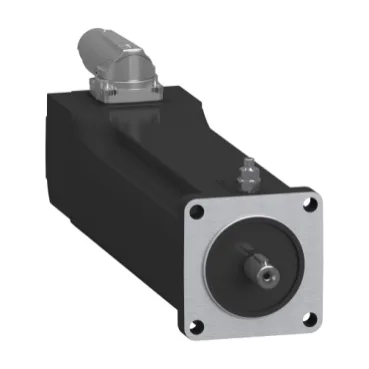
Where the SH3 SH30553P1BF4100 fits in a line
The SH30553P1BF4100 is the 55 mm flange member of the SH3 family with an integrated holding brake and an absolute multiturn Hiperface DSL encoder riding on a 9 mm keyed shaft — built for positioning axes that need to stop dead and remember their home position across power cycles. Its headline rating is 1.1 N.m of nominal torque at 230 V single phase stepping up to 680 W of continuous output at 400 V or 480 V three phase, which lands it at the lighter end of the servo workspace — point-to-point placement, indexing tables, small-format feed rollers, not the heavy lift side of the SH3 line.
Torque, speed and electrical envelope across the three supply rails
Nominal torque is 1.1 N.m at 230 V single phase and 0.81 N.m at both 400 V and 480 V three phase — the single-phase rating gives more torque per amp than the three-phase points because the three-phase busses push higher rotor speeds (8000 rpm at 400 V, 9000 rpm at 480 V) where the constant-power region trims the torque. Continuous output power is 390 W at 230 V single phase and 680 W at both 400 V and 480 V three phase, with a separately listed 680 W continuous power figure as the family's maximum — sizing pick is governed by the three-phase rail you actually feed into the drive. Electrical constants bound the drive to the motor: 10.4 Ohm stator resistance, 13.02 mH stator inductance, 0.62 N.m/A torque constant at 120 °C and 41 V/krpm back-EMF constant at 20 °C — these are the numbers that get cross-checked against the drive's auto-tune range when commissioning a replacement. Maximum current is 6.5 A Irms / 6.5 A 3 s peak and continuous stall current is 1.7 A — the drive's current loop must reach 6.5 A to deliver peak torque, and the holding brake holds 0.8 N.m against that level of torque after the motor is de-energised.
Brake, encoder and the shaft that goes back into the gearbox
The integrated holding brake pulls in with 10 W of brake pull-in power and delivers 0.8 N.m of holding torque — sized to lock the rotor against the rated static load when the drive is off, not to act as a dynamic safety stop in motion. Feedback is the absolute multiturn Hiperface DSL protocol over the single-cable quicklock connector — the encoder tracks the shaft's absolute position through power cycles, so the axis does not need a home-return after every restart. The shaft is 9 mm diameter by 20 mm long with a 3 mm parallel key, and the international standard flange takes 5.5 mm mounting holes at a 40 mm centring collar — the keying geometry is what a coupling or pinion is married to, so confirming it matches the gearbox in the BOM is the first cabinet-side check.
Environmental limits and cabinet-side mounting
IP65 covers both the motor body and the shaft bushing per IEC 60034-5 — the seal envelope is rated for splash and dust ingress, so the motor can sit close to a coolant line or a washdown zone, but it is not a submergence rating for cutting fluid sumps. Cooling is natural convection — no integrated fan, no blower loop — and the copper hot spot ceiling is 130 °C, so thermal headroom in a sealed cabinet is the binding constraint, not the motor's rated duty. Shaft loads are bounded by 710 N maximum radial force at 1000 rpm and 80 N maximum axial force — coupling alignment and belt tension sit inside that envelope; overhung loads above 1000 rpm get derated by the bearing curves.
Sourcing posture for SH30553P1BF4100
Lifecycle is recorded as current, so this motor is still on the active line — confirm the drive-side firmware bundle (Lexium or PacDrive variants) and the matching brake connector pinout against the in-cabinet unit before commissioning a swap, because the encoder protocol (Hiperface DSL) requires a compatible drive.