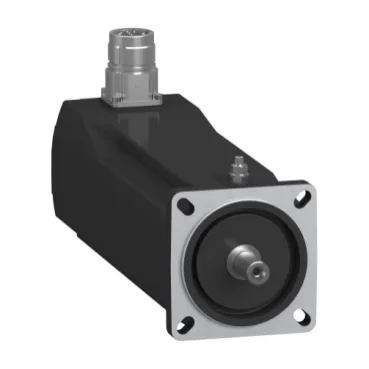
Motor ratings across supply voltages
The SH30702P0AF3000 delivers 1130 W continuous power on a three-phase 400 V or 480 V supply, dropping to 610 W on 230 V single-phase. Nominal speed reaches 3000 rpm at 230 V, 6000 rpm at 400 V, and 7200 rpm at 480 V — the speed ceiling follows the supply voltage, so the application's bus voltage sets the top end of the velocity loop. Nominal torque is 2.1 N·m on 230 V single-phase, derating to 1.8 N·m on three-phase supplies. The holding brake delivers 3 N·m holding torque, enough to secure a vertical axis without a counterbalance when the drive is disabled. Peak stall torque reaches 7.6 N·m across the 115–480 V three-phase range — this is the short-duration capability for acceleration and deceleration segments, not continuous duty. The continuous stall torque is 2.04 N·m at 2.9 A.
Feedback and mechanical interface
The absolute single-turn Hiperface DSL encoder provides position feedback over a digital serial link — no separate encoder cable needed; the motor power and feedback share a hybrid cable through the quick-lock straight connector. Single-turn means the absolute position is known within one revolution; multi-turn applications require a separate multi-turn encoder or homing cycle on power-up. Smooth shaft, 11 mm diameter, 23 mm length — no keyway, so the load coupling must transmit torque through a clamping or friction-fit method. The motor flange is 70 mm square with a 60 mm centring collar and 5.5 mm mounting holes, conforming to the international standard flange pattern. Overall length is 213 mm. IP65 on the motor body, but IP54 at the shaft bushing without the shaft seal ring fitted. For washdown environments, the shaft seal ring must be installed to maintain the IP65 rating at the output shaft. Natural convection cooling — no external fan, so the thermal budget depends on the motor's surface area and mounting plate heat sinking.
Electrical parameters for drive tuning
Maximum RMS current is 11.8 A — this is the peak the motor windings can sustain before thermal overload. The brake pull-in power is 7 W, typically fed from a 24 V DC supply; the brake release time and engage time affect the sequence logic in a vertical-axis application.