Supply-voltage-dependent performance — the spec that decides the application
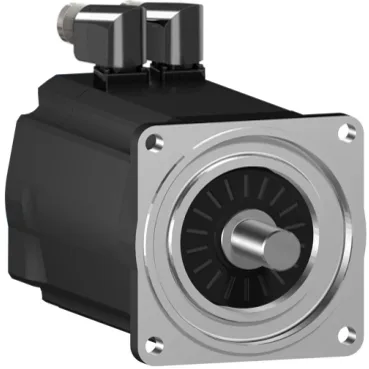
The SH31001P02A2100: This SH3 servo motor delivers different speed-torque-power combinations depending on the supply voltage. On three-phase 400 V it reaches 5000 rpm nominal speed with 2.27 N.m nominal torque and 1410 W output power; on 480 V three-phase the same torque holds but output climbs to 1630 W. On single-phase 230 V the nominal speed drops to 2500 rpm with 2.64 N.m torque and 790 W output; on 115 V single-phase it runs 1250 rpm at 2.91 N.m and 410 W. The continuous power rating of 1190 W sits between the single-phase and three-phase nominal outputs — a useful reference for sizing the drive and thermal budget. The continuous stall torque is 2.94 N.m across the 115–480 V three-phase range, with a continuous stall current of 3.5 A. Peak stall torque reaches 9.6 N.m at 12.0 A peak current.
Encoder, feedback, and integration constraints
The absolute multiturn SinCos Hiperface encoder provides high-resolution position feedback over multiple revolutions — no homing sequence needed on power-up. This encoder type is common on Schneider Lexium drive families; confirm the drive model supports Hiperface protocol before pairing. The motor has no holding brake. Applications requiring position hold at standstill must rely on the drive's dynamic braking or an external brake resistor. The smooth 19 mm shaft with 40 mm length accepts standard shaft couplings; the international standard flange with 100 mm flange size and 95 mm centring collar mounts to common servo gearboxes and machine frames. IP65 protection on both the motor body and shaft bushing means the unit withstands washdown and wet environments — suitable for food, beverage, or outdoor conveyor lines. The rotatable right-angled connector simplifies cable routing in tight panels or along machine frames.
Electrical parameters for drive tuning and thermal design
Maximum radial force Fr is 900 N at 1000 rpm, derating to 530 N at 5000 rpm; maximum axial force Fa is 160 N. These bearing load limits must be checked against the coupling and belt-drive forces in the application. Natural convection cooling means no external fan — the motor relies on its own surface area and mounting plate for heat dissipation; the hot-spot copper temperature is 130 °C.