Speed and torque across supply voltages
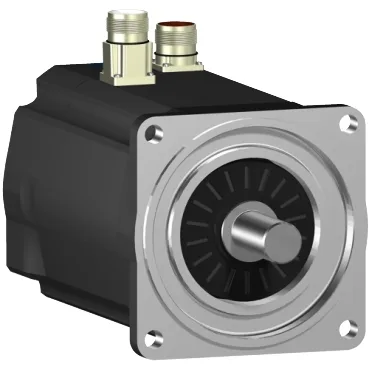
The SH31401P01A1200: On single-phase 115 V it runs 750 rpm; on 230 V single-phase it reaches 1500 rpm. Nominal torque follows the same pattern: 9.2 N·m at 400 V three-phase, 8.4 N·m at 480 V three-phase. The 400 V rating is the one to size against for standard European line voltages; the 480 V figure applies in North American 480 VAC installations. Continuous power at 400 V three-phase is 2890 W, and the continuous stall torque across the 115–480 V three-phase range is 11.1 N·m. That stall torque is the figure that governs holding torque at zero speed — relevant for positioning applications where the motor holds a load at rest.
Encoder and feedback — absolute single-turn SinCos Hiperface
The absolute single-turn SinCos Hiperface encoder reports position within one revolution on power-up, no homing cycle needed. The SinCos analog track gives interpolated position for smooth velocity control down to standstill — the drive reads the sine/cosine signals for sub-division beyond the raw encoder resolution. This encoder type mates with Schneider Lexium 32 and 62 drive families natively, and with third-party drives that support the Hiperface protocol. The straight connector is a standard industrial round connector — no special cable assembly required.
Mechanical fit — flange, shaft, and mounting
The motor flange is 140 mm (5.5 in) with a 130 mm centring collar and 11 mm mounting holes — this is the IEC standard B5 flange pattern. The smooth shaft is 24 mm diameter by 50 mm long, with a 3.5 mm centring collar depth. No keyway: the smooth shaft means the load coupling must use a clamping or friction-fit method. Maximum radial force at the shaft is 1930 N at 1000 rpm, dropping to 1340 N at 3000 rpm. Maximum axial force is 300 N. These limits govern bearing life when the load applies overhung or thrust loads — a belt drive or helical gearbox must stay within these to avoid premature bearing failure.
Thermal and electrical parameters
Cooling is natural convection — no fan, so the motor relies on its own surface area and the mounting flange for heat dissipation. The hot-spot copper temperature is rated at 130 °C. In a confined panel or enclosed mounting, the ambient temperature around the motor must stay within the motor's operating range to avoid thermal trip. Stator resistance is 1.41 Ω and inductance is 23.72 mH — these set the electrical time constant and influence the drive's current-loop tuning. The torque constant is 1.43 N·m/A at 120 °C copper temperature, and the back-EMF constant is 100 V/krpm at 20 °C. These constants let the drive calculate the motor's voltage demand at speed. Continuous stall current is 7.8 A; maximum RMS current is 20.8 A. The peak stall torque across the full voltage range is 27 N·m — that's the torque available for acceleration or for breaking a stuck load, limited by the drive's peak current capability.
Environmental protection and lifecycle
The motor body and shaft bushing are rated IP65 per IEC 60034-5; the housing is rated IP67. This means the motor withstands hose-directed water (IP65) and temporary immersion (IP67) — suitable for washdown areas in food processing or outdoor installations where the motor is not submerged continuously.