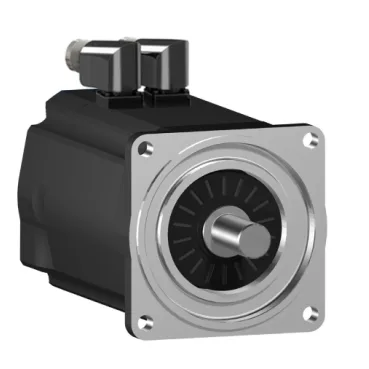
Power architecture and speed range
The SH31401P01F2200: This is a three-phase servo motor, so it needs a drive with a DC bus that can deliver the 20.8 A peak current. The nominal speed depends entirely on what voltage you feed it: 750 rpm on 115 V single phase, 1500 rpm on 230 V single phase, 3000 rpm on 400 V three phase, and 3600 rpm on 480 V three phase. That 3000 rpm at 400 V is the number most industrial lines will design around. Nominal torque also shifts with voltage — 9.2 Nm at 400 V three phase, dropping to 8.4 Nm at 480 V.
Brake and encoder — what they mean for the line
The integrated holding brake delivers 23 Nm of holding torque — enough to keep a vertical or Z-axis load stationary when the drive is disabled, without an external brake resistor or mechanical lock. The brake is part of the motor assembly, so it saves panel space and wiring compared to a separate brake unit. The absolute single-turn SinCos Hiperface encoder means the drive knows the rotor position at power-up — no homing sequence needed on each cycle. That matters for applications where the axis must resume position immediately after a power loss or emergency stop.
Environmental sealing and cooling
The motor body is IP65, the shaft bushing is IP65, and the housing is IP67 — all conforming to IEC 60034-5. That means the motor withstands washdown and hose-directed water, so it fits food-and-beverage lines or wet machining environments. Cooling is by natural convection — no fan, no filter to clean or replace. But that also means the motor needs free air circulation around the 140 mm flange. If it's boxed into a tight enclosure or mounted against a heat source, the 130°C copper hot-spot temperature will be reached sooner.