Speed-torque envelope across supply voltages
The SH31401P02A1200 delivers 3000 rpm nominal at 400 V three-phase input, with continuous torque of 9.2 N.m and continuous power of 2890 W. On 480 V three-phase it reaches 3600 rpm with 8.4 N.m and 3170 W — the higher bus voltage extends the speed range at the cost of torque derating. Single-phase 230 V yields 1500 rpm at 10.6 N.m; at 115 V single-phase it runs 750 rpm at 10.95 N.m. Peak stall torque is 27 N.m across the 115–480 V three-phase range, so acceleration capability holds regardless of supply voltage. The continuous stall torque sits at 11.1 N.m with a continuous stall current of 7.8 A — this is the holding torque at zero speed without exceeding the thermal limit.
Feedback, cooling, and mechanical interface
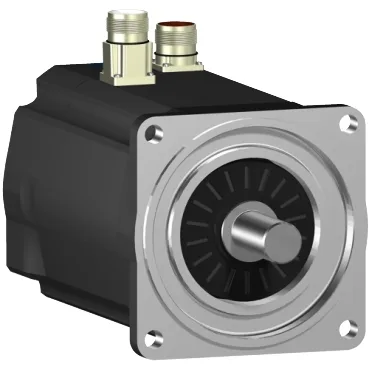
Absolute multiturn SinCos Hiperface encoder gives position feedback without a home cycle on power-up — the multiturn count tracks shaft revolutions even unpowered. The motor is naturally convection-cooled (no fan), so the thermal time constant is longer and the duty cycle must account for the absence of forced airflow. Smooth shaft (no keyway) with 24 mm diameter and 50 mm shaft length — coupling selection needs a clamping or friction-fit hub rated for the 27 N.m peak torque. The 140 mm flange mounts to the international standard pattern; centring collar diameter is 130 mm with 3.5 mm depth. Straight connector exits axially — plan cable clearance for the connector body. IP65 on the motor body and shaft bushing, IP67 on the housing — suitable for washdown zones where the connector is mated and the shaft seal is intact. No holding brake is fitted; any vertical-axis application requires an external brake sized for the load.
Electrical parameters for drive tuning
Stator resistance is 1.41 Ohm and inductance is 23.72 mH — these feed the drive's auto-tuning routine for current-loop gains and field-weakening thresholds. The torque constant is 1.43 N.m/A at 120 °C copper temperature; the back EMF constant is 100 V/krpm at 20 °C, so at 3000 rpm the motor generates 300 V line-to-line — the drive DC bus must stay above this to maintain current control. Maximum radial force at the shaft is 1930 N at 1000 rpm, derating to 1340 N at 3000 rpm — bearing life is sensitive to overhung loads at higher speeds. Maximum axial force is 300 N; thrust loads from helical gears or leadscrews must stay within this limit.