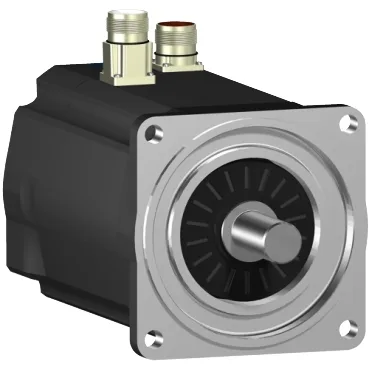
Speed-torque curves that shift with supply voltage
The SH31401P12A1100 delivers a nominal speed of 3000 rpm at 400 V three-phase, and 3600 rpm at 480 V three-phase — the winding is wound for the higher voltage, so the speed ceiling rises with the bus. At 115 V single-phase it drops to 750 rpm, and at 230 V single-phase it runs 1500 rpm. Torque follows a similar pattern: nominal torque at 400 V three-phase is 9.2 N·m, and at 480 V three-phase it's 8.4 N·m. If you're wiring this into a 480 V line, you get the highest top speed but slightly less continuous torque; the 400 V three-phase supply gives the best torque-per-amp trade-off. Continuous stall torque is 11.1 N·m across the 115...480 V three-phase range, and peak stall torque hits 27 N·m — that's the transient overload ceiling for acceleration or deceleration. The continuous stall current is 7.8 A, and the maximum RMS current is 20.8 A, so the drive must be sized to supply that peak without tripping.
Encoder feedback and IP sealing for washdown cells
The encoder is an absolute multiturn SinCos Hiperface — this gives position feedback on power-up without a homing move, and the SinCos analog track provides fine interpolation for the drive's current loop. The motor carries IP65 on both the housing and the shaft bushing, so it handles washdown in food or beverage lines as long as the mating connector is also IP-rated. Cooling is natural convection — no fan, so the thermal budget depends on the mounting flange's ability to sink heat into the machine frame. The stator resistance is 1.41 Ω and inductance 23.72 mH, which sets the electrical time constant at about 17 ms — the drive's current regulator must be tuned for this L/R ratio to avoid overshoot.