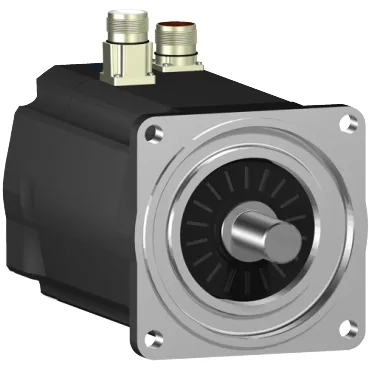
The SH31401P12F1200 is a three-phase servo motor from the SH3 series with an integrated holding brake — the brake holds 23 N.m (203.6 lbf.in) when the drive is off, so a vertical load on a gantry or hoist axis stays put without a mechanical brake on the load side. Continuous power is 2900 W, but the nominal output torque depends on the supply: at 400 V three-phase you get 9.2 N.m, at 480 V three-phase it's 8.4 N.m, and on single-phase 230 V it drops to 10.6 N.m — the torque is highest on the lower-voltage single-phase supply because the motor saturates differently, but the continuous power ceiling is set by the 2900 W thermal limit. The absolute multiturn SinCos Hiperface encoder means the drive knows the rotor position and the number of shaft turns after a power cycle — no homing sequence is needed on startup, which saves time on multi-axis machines that are power-cycled frequently. Peak stall torque is 27 N.m (239.0 lbf.in) across the 115–480 V three-phase range — this is the short-duration torque for acceleration and deceleration; the continuous stall torque is 11.1 N.m (98.2 lbf.in), which is what the motor can hold indefinitely at standstill without overheating.
Speed range and supply dependency
The nominal speed varies with the input supply: 750 rpm at 115 V single-phase, 1500 rpm at 230 V single-phase, 3000 rpm at 400 V three-phase, and 3600 rpm at 480 V three-phase — the motor is wound for a base speed that shifts with the DC bus voltage. At 480 V three-phase the nominal output power is 3170 W, slightly above the 2900 W continuous power rating — the extra margin means the motor can deliver full torque at that speed without exceeding the thermal limit, but the drive must be sized for the 20.8 A maximum current. The back EMF constant is 100 V/krpm at 20 °C — this sets the voltage the motor generates at speed; at 3600 rpm (3.6 krpm) the back EMF is 360 V, leaving headroom for the drive's PWM voltage to push current into the windings.
Thermal and mechanical limits
Cooling is by natural convection — no fan, so the motor relies on the mounting flange and ambient air to shed heat. The winding insulation is rated for 130 °C copper temperature, and the stator resistance is 1.41 Ohm with 23.72 mH inductance, so I²R losses dominate at high current. Maximum radial force on the shaft bearing is 1930 N at 1000 rpm, derating to 1340 N at 3000 rpm — a belt drive or direct coupling must stay within this envelope, or the bearing life shortens. Maximum axial force is 300 N. The motor flange is 140 mm (5.5 in) with an international standard pattern — the centring collar is 130 mm diameter, 3.5 mm deep, and the mounting holes are 11 mm diameter on the flange face.
Environmental sealing and connection
IP65 on the motor body and shaft bushing, IP67 on the housing — the motor tolerates washdown spray (IP65) and brief immersion (IP67) per IEC 60034-5, but the connector is a straight axial exit, not a right-angle one, so cable routing must allow for the axial clearance. The shaft is 24 mm diameter with a parallel key, 50 mm shaft length, and 8 mm key width — standard for coupling to a load via a keyed shaft or a clamping hub.