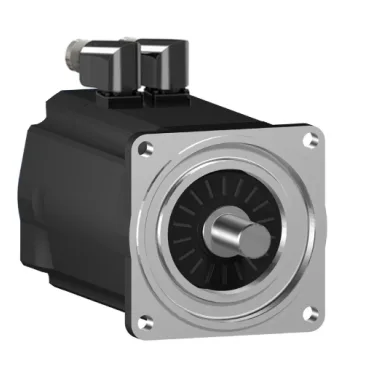
Supply-dependent performance — what the voltage ratings mean for your drive train
The SH31402P01A2200: This SH3 servo motor is a three-phase design, but its torque and speed curves shift depending on whether you feed it single-phase or three-phase line voltage — a detail that matters when retrofitting into an existing cabinet with a specific drive. At 400 V three-phase, nominal speed is 3000 rpm with 12.3 Nm torque; at 480 V three-phase, speed climbs to 3600 rpm but torque drops to 9.7 Nm. The continuous power also varies: 3860 W at 400 V three-phase, 3660 W at 480 V three-phase. If your line is 115 V single-phase, you get 1460 W at 750 rpm — a different machine entirely.
Torque delivery and thermal limits — sizing for real duty cycles
Natural convection cooling means no fan to fail, but the thermal budget is set by the stator resistance of 0.6 Ω and inductance of 11.225 mH. The maximum mechanical speed is 4000 rpm — the winding limits, not the bearings, are the ceiling.
Environmental sealing and feedback — where this motor lives
IP65 on the motor body and shaft bushing, IP67 on the housing — this motor handles washdown and splash zones without a secondary cover. The absolute single-turn SinCos Hiperface encoder gives position at power-up with no homing sequence, which saves time on multi-axis machines where the controller tracks the absolute position. The electrical connection is a rotatable right-angled connector — you can orient the cable exit to clear the machine frame or cable track without adding a junction box. The flange is the international standard 140 mm size with a 130 mm centring collar and 11 mm mounting holes. Overall length is 272.5 mm with a 24 mm smooth shaft — no keyway, so the coupling must clamp or use a friction fit.