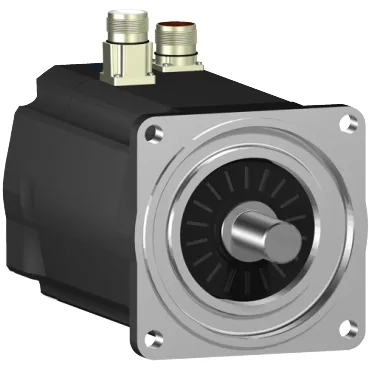
What this servo motor delivers — and what the ratings actually mean for your line
The SH31402P01F1100 is a three-phase servo motor from Schneider Electric's SH3 family, built with a holding brake and an absolute single-turn SinCos Hiperface encoder. The 23 Nm holding torque means the motor locks the load in position when power is removed — no need for a separate mechanical brake on the driven axis, which simplifies the mechanical build and saves panel space. Rated for 3900 W continuous power, this motor is sized for applications like conveyor drives, indexing tables, and packaging machinery where the load profile demands sustained torque at moderate speeds. The IP65 rating on both the motor body and the shaft bushing means it withstands washdown — suitable for food-and-bev lines or other wet environments without an additional enclosure. The nominal speed and torque change with the supply voltage: at 400 V three-phase you get 3000 rpm and 12.3 Nm nominal torque; at 480 V three-phase it's 3600 rpm and 9.7 Nm. That voltage dependency is the single most important thing to confirm against your drive and line supply before committing the BOM.
Mounting and integration — flange size, shaft, and what connects where
The motor uses an international standard flange with a 140 mm flange size and a 130 mm centring collar diameter. The shaft is 24 mm diameter, 50 mm long, with a smooth end — no keyway, so the coupling or pulley must clamp directly onto the shaft. Mounting holes are 11 mm diameter on a standard bolt circle. Electrical connection is via a straight connector — no right-angle adapter needed, which helps when routing the motor cable in tight cable trays or along the machine frame. The encoder connection uses the Hiperface protocol, a single-turn absolute type, so the controller knows the exact shaft position on power-up without a homing cycle. Maximum radial force at the shaft is 2240 N at 1000 rpm, dropping to 1550 N at 3000 rpm. Maximum axial force is 300 N. Stay within these limits to avoid bearing damage — the motor is convection-cooled, so there's no fan to pull cooling air over the windings; derate if you mount it in a confined space with restricted airflow.
No stock-holding claim here — we confirm the supply position when you send the RFQ.